In 30 Seconds
As humanoid robots scale from pilot prototypes to factory floor deployments in 2026, the motion control architecture has stabilized into a proven consensus: rotary harmonic joint modules dominate upper-body dexterous articulation (arms, wrists, and waist), while inverted planetary roller screw linear actuators power high-load bipedal locomotion (hips, knees, and ankles). This breakdown analyzes how a standard 28–32 DOF humanoid platform allocates joint types, torque-to-weight ratios, and 48V power budgets.
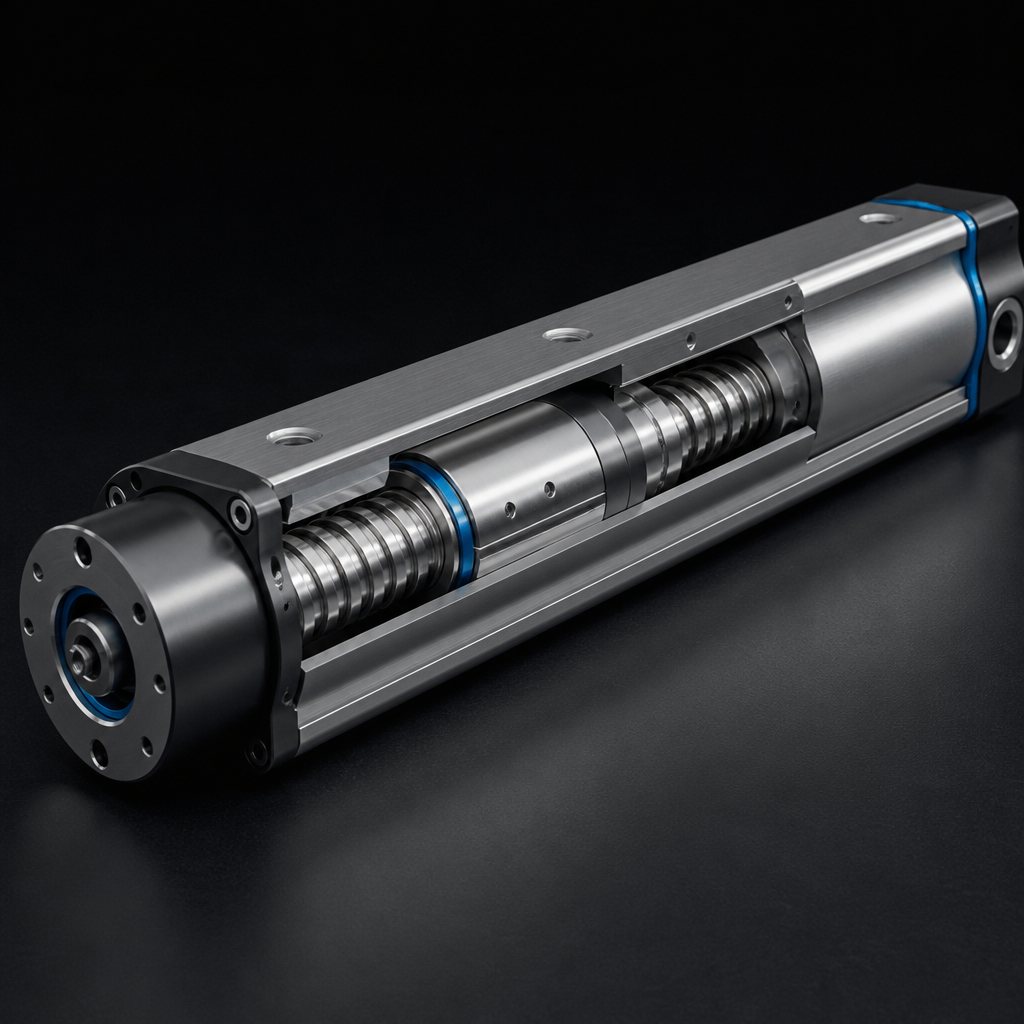
Inverted planetary roller screw linear actuators deliver over 1,100 N rated thrust for humanoid knee and hip pitch axes.
1. The 2026 Paradigm Shift: Specialized Joint Topologies
In early research prototypes, humanoid builders often attempted to standardize on a single actuator topology—typically rotary quasi-direct-drive (QDD) or standard harmonic gearheads across all axes. However, field validation in automotive and electronics assembly lines throughout 2025–2026 revealed strict physical bottlenecks:
- Upper-body limbs demand zero backlash and compact packaging: Robot arms and wrists prioritize volumetric torque density, sub-arc-minute backlash, and hollow-shaft internal cable routing to handle dynamic payload manipulation.
- Lower-body limbs demand extreme linear force density and shock tolerance: Bipedal walking, heel-strike impacts, and squatting create dynamic loads exceeding 2,000 N at the knee and hip joints. Rotary reducers subjected to repeated vertical impact shocks suffer accelerated fatigue wear on flexspline teeth.
Consequently, commercial humanoid architectures in 2026 distinctly separate into rotary joint modules for dexterous manipulation and linear roller screw modules for high-thrust leg kinematics.
2. Complete 28–32 DOF Humanoid Joint Mapping Table
The following mapping represents the mainstream industrial humanoid joint topology deployed across leading 2026 commercial platforms:
| Joint Location | Primary Motion Role | Actuator Topology | Typical Spec / Sizing | Recommended PlaPivot Module |
|---|---|---|---|---|
| Shoulder Pitch / Roll | Arm lifting & abduction | Rotary Harmonic | 70–107 Nm rated, <1 arcmin | PP-17 / PP-20 |
| Shoulder Yaw / Elbow Pitch | Arm reach & elbow flexion | Rotary Harmonic (or PRO) | 36–51 Nm rated, dual encoder | PP-14 / PP-70-PRO |
| Wrist Pitch / Yaw / Roll | Dexterous end-effector pose | Compact Rotary Harmonic | 4.5–18 Nm rated, ultra-light | PP-08 / PP-11 |
| Waist / Torso Yaw & Pitch | Upper body stabilization | High-Torque Rotary PRO | 64–107 Nm, integrated torque sensor | PP-80-PRO / PP-20 |
| Hip Pitch / Knee Flexion | Locomotion & deep squat lift | Linear Roller Screw (Inverted) | 880–1100 N thrust, 69–100mm stroke | PP-20L / PP-50L |
| Ankle Pitch & Roll | Foot ground adaptation | Dual Linear Push-Rod (or PRO) | 880 N thrust or 51 Nm high-bandwidth | PP-20L / PP-70-PRO |
3. Why Inverted Planetary Roller Screws Outperform Ball Screws
When selecting linear actuators for humanoid legs, engineering teams frequently evaluate ball screws versus inverted planetary roller screws (IPRS). In 2026 mass production, roller screws have become the clear winner for four key technical reasons:
- Multiple Line Contact vs. Point Contact: Planetary roller screws utilize threaded rollers encircling the screw shaft. This provides significantly larger contact surface area, increasing dynamic load capacity by 300% to 500% over ball screws of identical diameter.
- Shock Load Tolerance: When a 60 kg humanoid robot lands dynamically or stumbles, instantaneous impact accelerations create localized point Brinelling on ball screw races. Roller screws distribute contact pressure across multiple engagement lines, virtually eliminating permanent race deformation.
- Compact Axial Packaging (Inverted Design): Inverted roller screw designs place the rotating nut inside the rotor of a frameless hollow-shaft motor, allowing the linear push-rod to telescope directly through the motor axis. This cuts total joint length by 35%.
- High Linear Precision: Dual linear absolute feedback enables ±0.02 mm positioning repeatability and high dynamic response under full rated thrust.
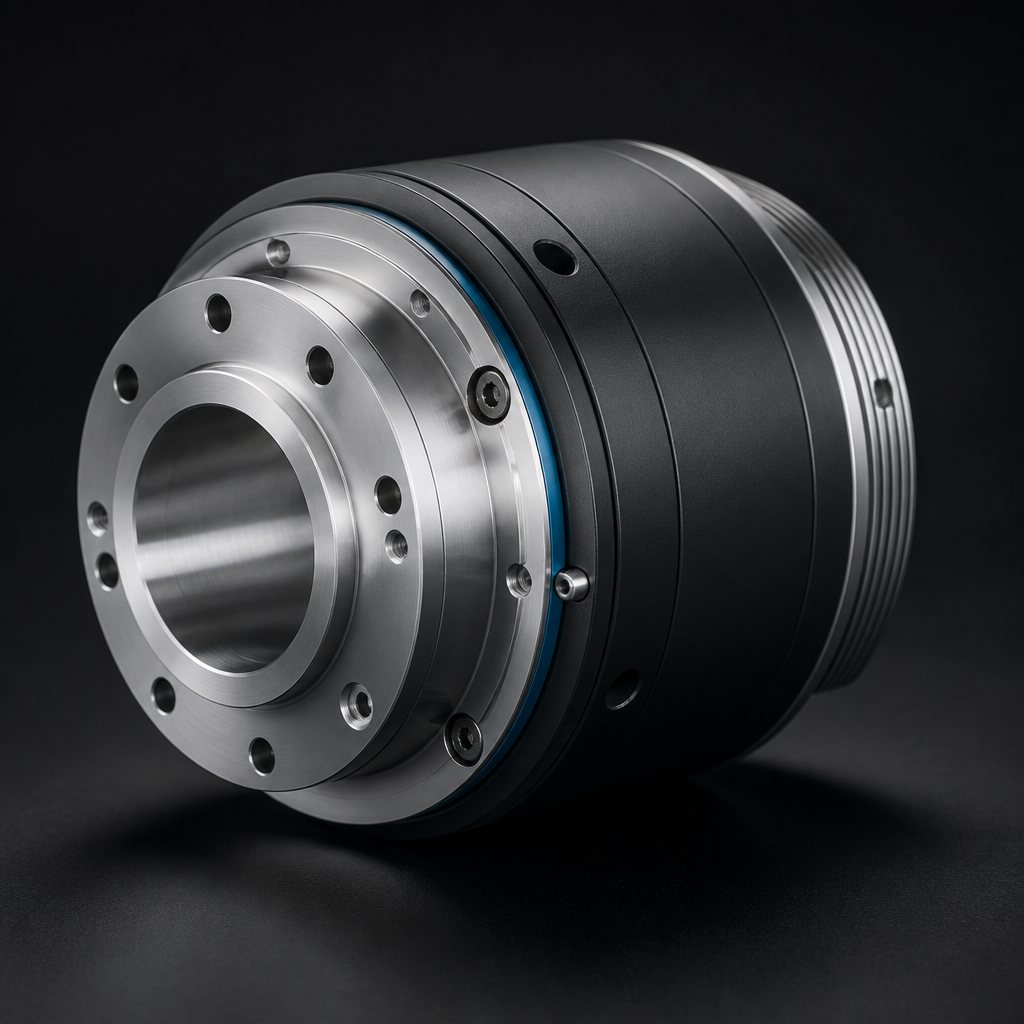
Rotary harmonic joint modules provide high power density and hollow-shaft routing for upper-body dexterous manipulation.
4. Electrical & Thermal Consensus: The 48V Industrial Standard
Modern humanoid platforms have unified around a 48V DC bus architecture. Operating at 48V provides substantial benefits over lower 24V or higher 300V+ industrial voltages:
- Low Wire Harness Mass: Reduces phase current requirements by half compared to 24V, dramatically lightening internal cable bundles routed through narrow robotic limbs.
- Safety & Fast Battery Integration: 48V is within Extra-Low Voltage (SELV) safety guidelines, simplifying maintenance and regulatory certifications.
- Deterministic Synchronization: Distributed EtherCAT and CAN FD slaves embedded inside each PlaPivot joint module synchronize 30+ motion axes within sub-millisecond clock jitter.
5. Summary & Recommendations for Robotics Builders
When architecting next-generation robotic limbs, avoiding over-generalized joint selection is essential for production viability:
- Use Harmonic Rotary Joints (PP-08 to PP-20) where rotational range of motion, zero backlash, and hollow-shaft packaging dominate.
- Use PRO Six-in-One Joints (PP-60-PRO to PP-80-PRO) on axes requiring active compliance and physical AI contact force control.
- Use Linear Roller Screw Joints (PP-20L to PP-50L) for heavy bipedal loads, high-impact vertical thrust, and compact push-rod linkages.
Architecting a Humanoid or Bipedal Robot?
Explore PlaPivot's 14 standard integrated rotary and linear joint modules. Request 3D STEP files, torque curves, and small-batch pricing for engineering prototypes.
Request CAD & Quotation