In 30 Seconds
Japan's care-worker shortage is the largest robotics market pull in the world, and it has a different engineering profile from industrial automation: low speeds, moderate torques, strict safety limits, and a premium on light weight. This guide explains how to spec a care robot actuator or service robot joint module — including a worked joint map for a care-assist arm built from PP-series modules.
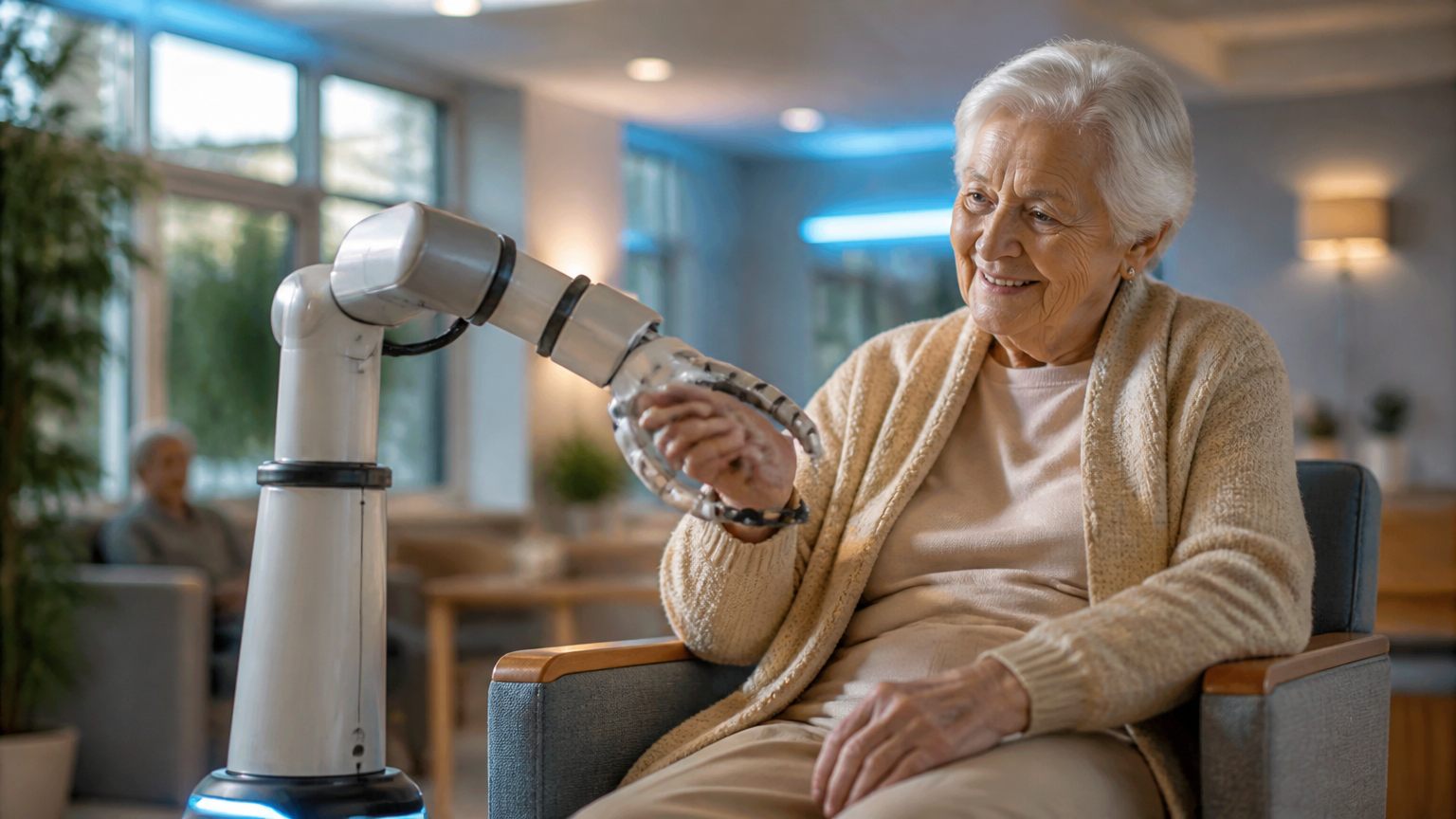
Care robots operate in human environments — safety and gentleness are the primary specs.
1. The Market Pull: Japan's Aging Society
By 2040, roughly one in three people in Japan will be over 65, and the working-age population that provides care is shrinking faster than demand. Government strategy has pushed assistive and care robotics for over a decade — from lifting support suits to meal-delivery robots and rehabilitation devices — and the care robot actuator market is now one of the fastest-growing segments in Asian robotics.
What this means for component suppliers: care robots are built in much lower volumes than industrial arms, by startups and mid-size integrators, who need catalog components they can assemble quickly. An off-the-shelf joint module with integrated driver and absolute encoders collapses months of motor-driver-gearbox integration into days.
2. The Care Robot Joint Profile: Low Speed, High Torque
Care tasks — transferring a patient, adjusting a bed, lifting a meal tray, assisting a sit-to-stand motion — are nothing like pick-and-place. The defining spec is low speed high torque: motion at 5–20 RPM output, holding torque at static poses, and smoothness that feels intentional rather than robotic. The harmonic-drive PP-series maps directly:
| PP Module | Rated Torque | Weight | Typical Care Role |
|---|---|---|---|
| PP-08 | 4.5 Nm | Current datasheet | Wrist, finger-drive, tray tilt |
| PP-11 | 10.5 Nm | Current datasheet | Wrist and light reach assist |
| PP-14 | 36 Nm | Current datasheet | Elbow and light-arm shoulder |
| PP-17 | 70 Nm | Current datasheet | Shoulder and transfer-assist lift |
| PP-20 | 107 Nm | Current datasheet | Base joints of higher-load care arms |
Care profiles usually prioritize smooth low-speed motion and holding margin. Use the rated-speed and duty-cycle values for the selected current model rather than transferring a legacy-series speed assumption into a new design.
3. Lightweight Service Robot Joint Modules
Mass is not a minor detail in care robotics: an arm that is comfortable on a wheelchair mount, or safe to support during a transfer, must keep moving mass low. A lightweight service robot joint module is the difference between a feasible product and a spec-sheet dream:
- PP-08 and PP-11 are the current compact starting points for low-load wrist and tray axes; confirm final mass and torque-to-weight ratio from the selected model datasheet.
- Integrated driver removes the separate control box that most custom builds require.
- 48 V DC lets the whole robot run from a single battery — most service robots are mobile.
For the mechanical trade-offs of building an arm from standardized modules, our modular arm design guide covers the framework.
4. Human-Friendly Torque Control
The engineering requirement behind "human-friendly" is assistive robot arm torque control that behaves safely on contact. On the PP-series this is supported at the joint level by:
- 17-bit dual absolute encoders (motor + output): the controller sees the difference between motor position and output position — the twist that signals contact — and can stop or yield within a control cycle.
- Per-joint torque and velocity limits: hard boundaries configurable in the driver, giving the safety logic an enforced ceiling rather than a software suggestion.
- Brake configuration should be specified when the arm must hold pose after power loss, especially when it is supporting a person's weight.
This is the same collision-detection mechanism used in collaborative industrial arms; see our cobot joint guide for the deeper treatment.
5. Worked Example: A Care-Assist Arm
Take a 4-DOF assist arm for meal assistance and light transfers, 0.7 m reach, 2 kg tool + 1.5 kg payload, running on battery:
| Joint | Calc. Peak (Nm) | Module | Headroom |
|---|---|---|---|
| J1 (Base) | 22 | PP-14 (36 Nm) | 64% |
| J2 (Shoulder) | 18 | PP-14 (36 Nm) | 50% |
| J3 (Elbow) | 9 | PP-11 (10.5 Nm) | 14% |
| J4 (Wrist) | 4 | PP-08 (4.5 Nm) | 11% |
The large headroom on J2 is deliberate: care arms must never run at torque limits in normal use, because the control loop needs headroom to yield safely on contact.
6. Hygiene and Cleanability
Care devices are wiped down daily. Confirm the selected module's ingress rating, connector sealing and cleanability requirements during quotation; do not assume that a general-purpose configuration is suitable for a disinfectant or wash-down process.
Building a Care or Service Robot?
Send us your arm's reach, payload and speed profile — we'll validate the joint map, provide CAD models and quote within 24 hours.
Request Quote & Datasheet