Collaborative robots, or 'cobots,' are designed to work alongside humans without safety fences. This paradigm shift requires a new type of robot joint—one that isn't just precise, but inherently safe. Building or selecting a cobot joint module involves navigating complex safety standards and understanding how mechanical design impacts functional safety.
1. Functional Safety and ISO 10218-1
A true cobot joint must support functional safety features like 'Safety-Rated Monitored Stop' and 'Power and Force Limiting' (PFL). This usually means the integrated driver has redundant circuits to monitor the joint's speed and torque. If the torque exceeds a pre-defined threshold (indicating a collision with a person), the joint must cut power or reverse direction in milliseconds. Our PP-series modules are designed with these standards in mind, providing high-speed 'Safe Torque Off' (STO) inputs and real-time torque feedback that allows the main controller to implement ISO 13849-compliant safety loops.
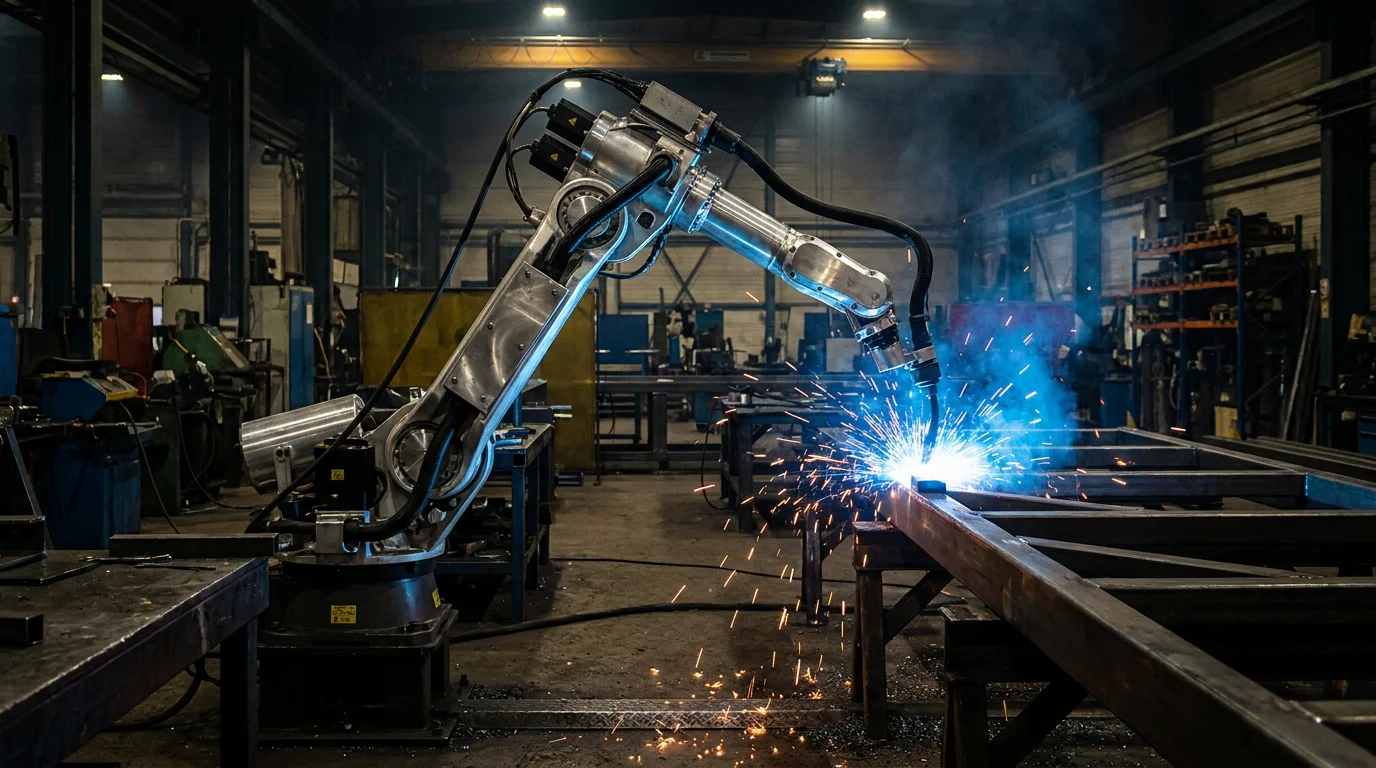
Technical illustration for Collaborative Robot Joint Modules: Safety, Compliance and Selection.
2. Force Sensing without External Sensors
One of the most impressive features of modern cobot joints is the ability to sense 'touch' without expensive 6-axis force/torque sensors at the wrist. By using high-resolution 23-bit encoders and monitoring the 'current' (amperage) of the motor, the joint can calculate the external force being applied to it. This 'sensorless' force detection allows for 'hand-guiding'—where a human can grab the robot and 'teach' it a path by moving it manually. This requires a joint module with extremely low internal friction and a very high-quality harmonic drive, as any 'cogging' or 'stiction' would be misinterpreted as an external force.
3. Compactness and 'Human-Friendly' Design
Safety isn't just about software; it's about physical form. Cobot joints should be smooth, rounded, and free of 'pinch points' where a human finger could be caught. The integrated nature of our PP-series modules is perfect for this. By hiding the motor, cables, and driver inside a smooth aluminum cylinder, the robot's exterior remains safe to touch. The hollow-shaft design also allows all wiring to be kept inside the robot's arm, eliminating the risk of cables snagging on workers or equipment in a busy factory environment.
Technical illustration for Collaborative Robot Joint Modules: Safety, Compliance and Selection.
4. Choosing the Right Module for Collaborative Tasks
When selecting a module for a cobot, weight is your enemy. The more mass the robot arm has, the more 'kinetic energy' it carries, and the harder it hits during a collision. Choosing lightweight, high-torque-density modules like the PP-80S allows you to build an arm that is 'light on its feet.' You should also look for modules with 'Dual Absolute Encoders,' as these provide the redundant position data required for many safety certifications. Whether you're building a robot for coffee brewing, lab automation, or light assembly, the 'Safety-First' architecture of the PlaPivot series provides a solid foundation for your cobot project.
Ready to start your build?
Our engineering team is ready to help you select the perfect robot joint modules for your application. Get expert advice and a custom quotation within 24 hours.
Get a Quote & DatasheetRelated articles you might find useful: