One of the most common pitfalls in robot design is underestimating the torque required for each joint. An undersized joint will lead to shaky motion, overheating, and frequent system failures, while an oversized joint adds unnecessary weight and cost. This guide breaks down the technical formulas and practical considerations for calculating torque requirements in multi-axis robotic arms.
1. Static Torque: Calculating the Holding Load
The first step in sizing a joint is calculating the static torque required to hold the arm and payload against gravity. This is a simple 'Force x Distance' calculation, but it must be performed for the worst-case scenario: when the arm is at maximum horizontal extension. In this configuration, the gravity vector is perpendicular to the arm, creating the maximum moment arm. You must sum the moments for the payload, the weight of the links, and the weight of the distal joint modules themselves. For example, if a shoulder joint (J2) is 800mm from a 5kg payload, the static torque due to the payload alone is roughly 5kg * 9.81m/s^2 * 0.8m = 39.24 Nm. Don't forget to add the mass of the arm structure!
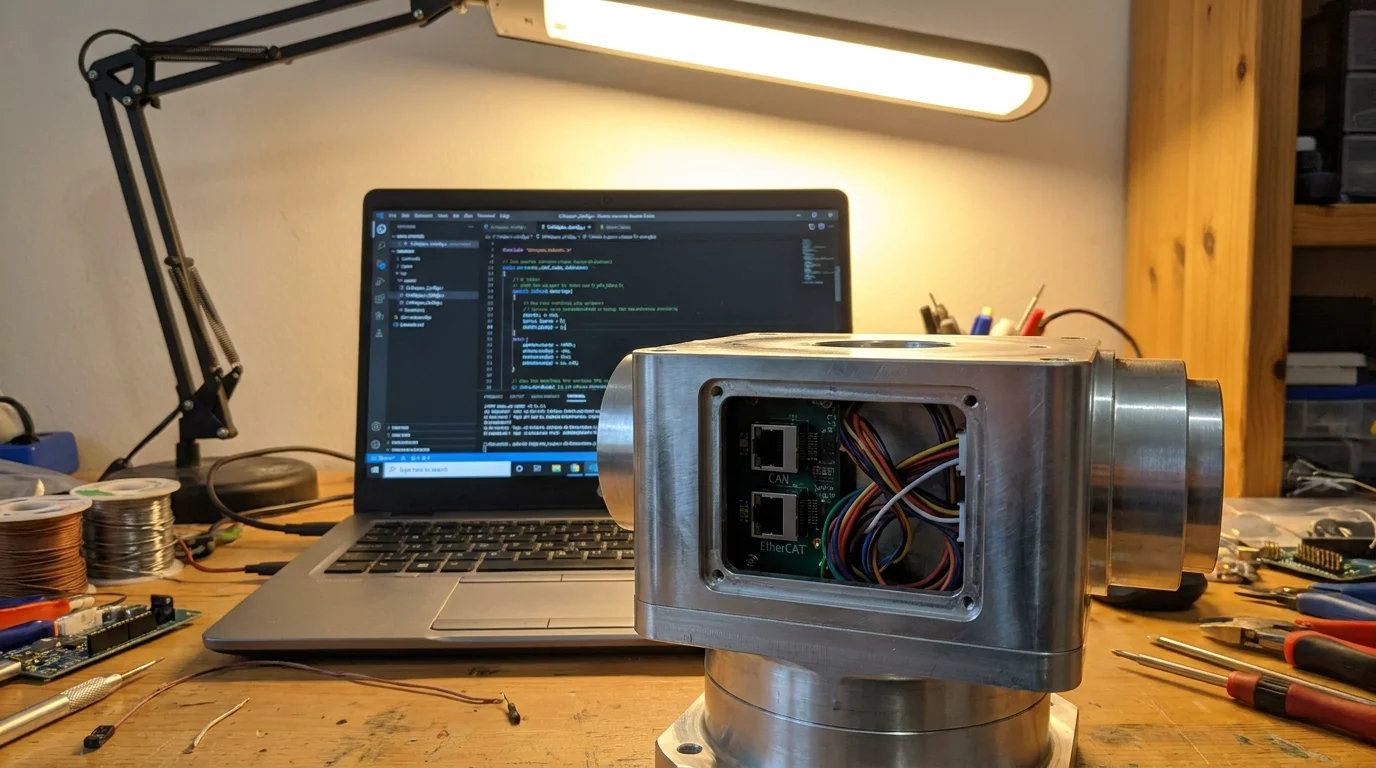
Technical illustration for How to Calculate Torque Requirements for Robot Joints.
2. Dynamic Torque: Overcoming Inertia
Robots don't just hold still; they accelerate. Dynamic torque is the additional force needed to change the velocity of the arm. This is governed by the formula T = I * alpha, where 'I' is the moment of inertia and 'alpha' is the angular acceleration. Calculating the moment of inertia for a complex robotic arm requires summing the inertia of each component (payload, links, motors) relative to the axis of rotation. High-speed 'pick-and-place' applications often require dynamic torque that is 2 to 3 times higher than the static holding torque. When using our PP-series modules, you should check the peak torque rating to ensure the module can handle these short-duration acceleration spikes without tripping a current limit.
3. The Importance of Safety Margins and Headroom
In the world of industrial engineering, a safety factor is non-negotiable. For robot joints, we recommend a torque headroom of at least 20-30% above your highest calculated peak. This margin accounts for several real-world variables: friction in the gear reducer (which increases as the lubricant ages), efficiency losses at high temperatures, and inertial shocks during emergency stops. If your calculation suggests a peak load of 45Nm, selecting a 55Nm module like the PP-120S is a much safer choice than a 45Nm module that will constantly run at its thermal limit. A joint running within its continuous torque range will have a significantly longer lifespan and provide much smoother motion control.
Technical illustration for How to Calculate Torque Requirements for Robot Joints.
4. Using Torque-Speed Curves for Final Selection
Finally, you must consult the torque-speed curve (often called a 'dyno curve') provided by the manufacturer. Torque is not constant across all speeds; as the motor spins faster, 'back-EMF' reduces the available torque. A joint that provides 60Nm at standstill might only provide 30Nm at its maximum rated speed of 30 RPM. Ensure that your application's required duty cycle falls within the 'Continuous Duty' (S1) region of the curve. If your robot needs to move fast and heavy, you might need a module with a lower gear ratio or a higher voltage bus (e.g., 48V instead of 24V) to maintain torque at high velocities. Our engineering team provides detailed STEP files and performance charts for all PP-series models to assist in this calculation.
Ready to start your build?
Our engineering team is ready to help you select the perfect robot joint modules for your application. Get expert advice and a custom quotation within 24 hours.
Get a Quote & DatasheetRelated articles you might find useful: