Choosing the right gearbox is the most critical decision when designing a robot joint. The two heavyweights of the industry are Harmonic Drives (Strain Wave Gears) and Cycloidal Drives. While both are designed for high reduction in a compact space, they have vastly different performance characteristics that suit different robotic applications.
1. Harmonic Drives: The King of Precision
Harmonic drives are the gold standard for collaborative robots (cobots) and precision manipulators. They operate on the principle of elastic deformation: an elliptical 'Wave Generator' deforms a flexible 'Flexspline' to engage with a rigid 'Circular Spline.' Because there are many teeth in contact simultaneously, harmonic drives offer virtually zero backlash and exceptional repeatability. They are also incredibly compact and lightweight, boasting the highest torque-to-weight ratio in the industry. For a 6-axis arm where every gram of weight in the wrist (J4-J6) must be carried by the shoulder (J2), the weight savings of a harmonic drive are invaluable. This is why PlaPivot's PP-series modules utilize high-grade harmonic reducers for all precision models.
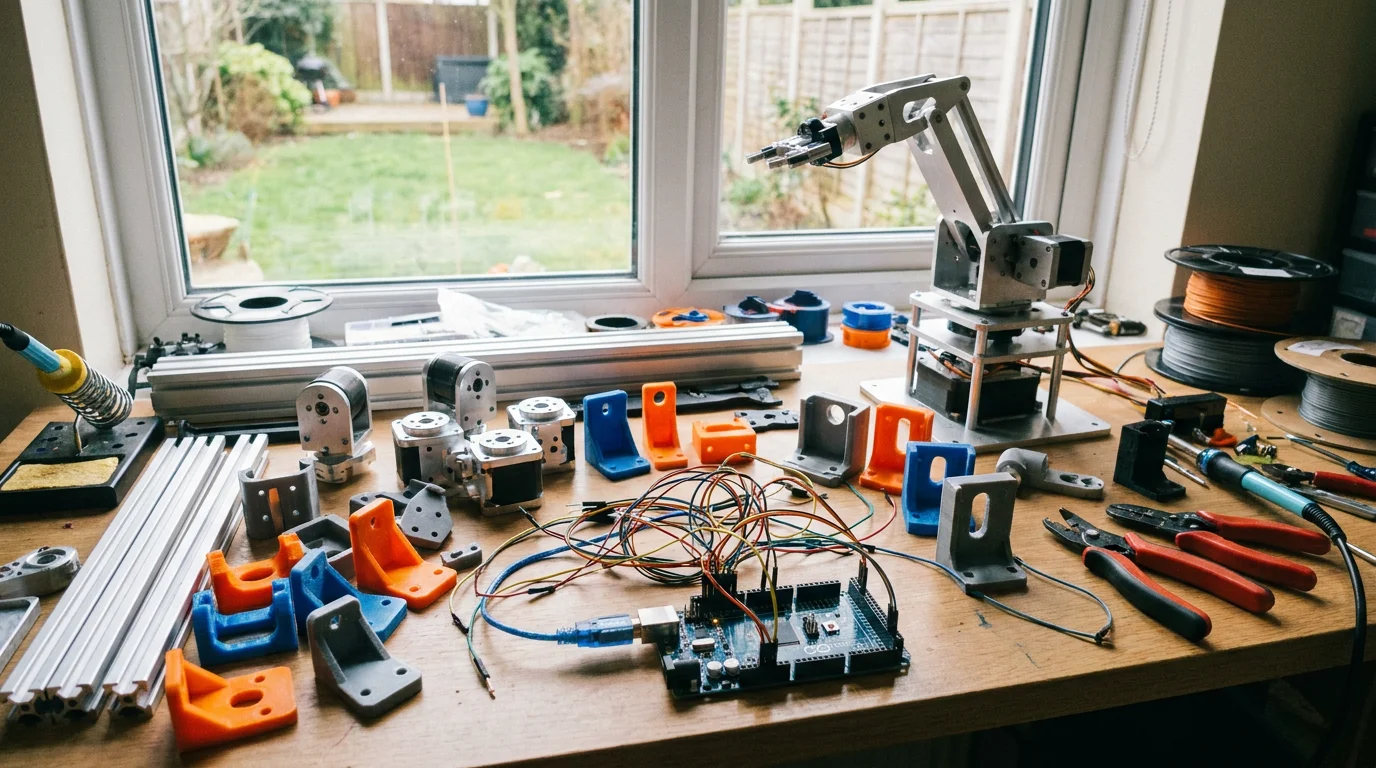
Technical illustration for Harmonic Drive vs Cycloidal Drive: Which Gearbox for Your Robot Joint.
2. Cycloidal Drives: Built for Brute Force
Cycloidal drives use eccentric cam-driven discs to roll along the internal pins of a housing. Unlike harmonic drives, there are no flexible parts that can fatigue over time. This makes cycloidal drives exceptionally robust and resistant to 'shock loads'—sudden impacts that might snap the flexspline of a harmonic drive. They also tend to have higher mechanical efficiency (often over 90%) and better stiffness under heavy loads. However, they are typically heavier and more complex to manufacture with zero backlash. You'll often find cycloidal drives in the base joints (J1 and J2) of large industrial robots or in heavy-duty AGV drive wheels where durability and impact resistance are prioritized over absolute weight savings.
3. Direct Comparison: Precision, Weight, and Cost
When comparing the two, the trade-offs are clear. Harmonic drives win on precision (backlash < 1 arc-min) and weight, but are more susceptible to damage from emergency stops and are generally more expensive due to the specialized materials required for the flexspline. Cycloidal drives win on torque density and shock resistance, but often have a small amount of backlash (3-5 arc-min) unless preloaded, which can introduce friction. For high-speed pick-and-place or surgical robotics, the harmonic drive is the only choice. For heavy palletizing robots or outdoor mobile platforms, the cycloidal drive offers better long-term reliability in harsh conditions.
Technical illustration for Harmonic Drive vs Cycloidal Drive: Which Gearbox for Your Robot Joint.
4. Which One Should You Choose for Your Robot?
If you are building a cobot, a humanoid, or a desktop robotic arm, go with a harmonic drive integrated module. The zero-backlash nature allows for much easier control loops and better path accuracy. At PlaPivot, we've optimized our PP-series to use harmonic drives that balance cost and performance, making precision robotics accessible for small-batch manufacturing. If you are building a heavy-duty industrial positioner or an autonomous mobile robot (AMR) where the joint might hit obstacles, a cycloidal or planetary system might be more appropriate. Always consider the total weight of your arm; saving 500g at the wrist can save 5Nm of torque requirement at the shoulder!
5. The Spec Sheet Numbers: A Side-by-Side Reference
When datasheets sit side by side, the trade-offs collapse into a handful of rows:
| Parameter | Harmonic (strain wave) | Cycloidal |
|---|---|---|
| Backlash | <1 arcmin, effectively zero when preloaded | 1–3 arcmin as built; <1 arcmin when preloaded |
| Efficiency | ≈70–85% depending on ratio and lubrication | 90%+ typical |
| Shock resistance | Moderate — the flexspline is the weakest link | High — no flexing parts to fatigue |
| Weight | Best torque-to-weight in the industry | Heavier for the same torque |
| Stiffness under load | Good; compliance grows near peak torque | Higher torsional stiffness at heavy loads |
| Typical joint | Wrist and elbow (J3–J6) | Base and shoulder (J1–J2), heavy-duty positioners |
This is why the practical answer is often both: a harmonic module in the wrist where every gram multiplies through the shoulder, and a cycloidal or planetary stage at the base where the joint must absorb impacts and carry everything above it.
6. A Worked Example: Mapping a 6-Axis Arm
Take a 6-axis arm for a 5 kg payload with a 0.8 m reach. Static and dynamic torque analysis gives continuous-class peaks of roughly 100 Nm at the base, 36 Nm at the elbow, and 10.5 Nm or less at the wrist:
- Base / shoulder (J1–J2): PP-20 harmonic module, 107 Nm at 1.43 kg, sized with 25%+ headroom above the calculated peaks.
- Elbow (J3): PP-14, 36 Nm at 0.7 kg.
- Wrist (J4–J6): PP-11 (10.5 Nm, 0.37 kg) and PP-08 (4.5 Nm, 0.16 kg) — light enough that the shoulder does not need to be oversized.
If the same arm must run force-limited or collaborative tasks, the PRO series (PP-60/70/80-PRO, 18/51/64 Nm) with integrated torque sensors replaces current-based collision detection with direct force measurement — the sensing foundation behind ISO/TS 15066 power-and-force limiting. For budget or education builds where crash resistance matters more than precision, the planetary series (PP-10G/20G/40G, 10/20/40 Nm) covers elbow and wrist duties at lower cost — at the price of the sub-arc-minute backlash that harmonic drives eliminate.
7. Three Questions That Settle the Debate
- ☐ Will the joint ever absorb impacts (crashes, palletizing, AMR bumpers)? → cycloidal or planetary.
- ☐ Is mass at the wrist the bottleneck for the rest of the arm? → harmonic.
- ☐ Do I need direct force sensing for safe or adaptive operation? → PRO with torque sensor.
Specify the transmission for the worst-case load, the precision for the tightest tolerance, and the sensing for the risk profile — most arms end up with a mix, and an integrated-module lineup exists precisely for that reason.
Ready to start your build?
Our engineering team is ready to help you select the perfect robot joint modules for your application. Get expert advice and a custom quotation within 24 hours.
Get a Quote & DatasheetRelated articles you might find useful: