The evolution of robotics has seen a dramatic shift from bulky, discrete component assemblies to sleek, highly integrated robot joint modules. These modules, often called 'integrated actuators,' combine everything needed for motion into a single package. Understanding how they work is essential for any engineer looking to build compact, high-performance robotic systems like cobots, exoskeletons, or humanoid platforms.
1. The Anatomy of Integration: Four Pillars of Motion
A modern robot joint module is a masterpiece of mechatronic engineering, integrating four critical systems: the motor, the gear reducer, the encoders, and the control electronics. At the core is usually a frameless brushless DC (BLDC) torque motor, designed to provide high torque in a compact, hollow-shaft form factor. Surrounding this is the harmonic drive reducer, which provides the necessary torque multiplication and zero-backlash precision. Two absolute encoders monitor the position on both the input (motor) and output (joint) sides, while an integrated servo driver handles the low-level power electronics and communication. By combining these into a single housing, manufacturers eliminate the need for complex mechanical alignment and heavy cabling, significantly reducing the robot's overall weight and development time.
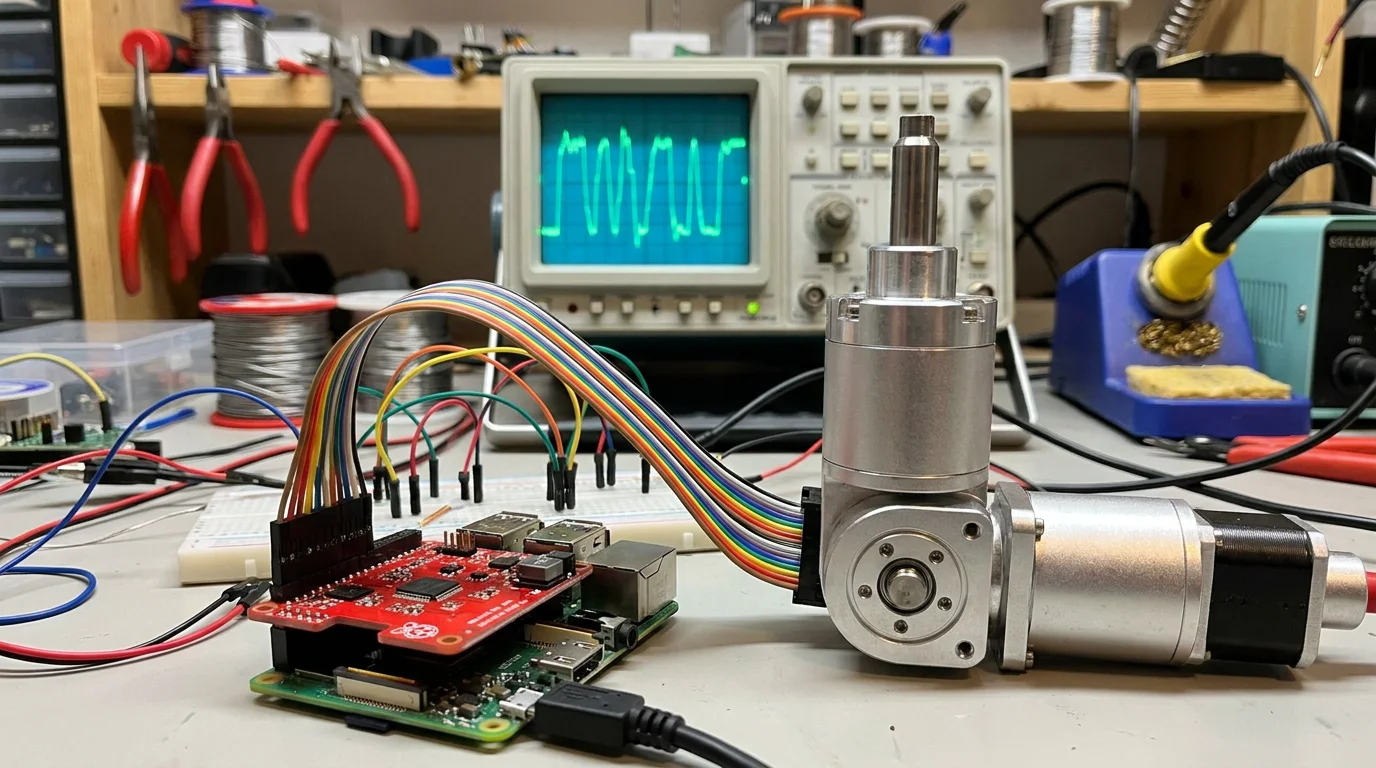
Technical illustration for How Robot Joint Modules Work: A Technical Deep Dive.
2. The Precision of Harmonic Drive Reducers
The 'secret sauce' in most high-end robot joints is the harmonic drive, or strain wave gear. Unlike traditional planetary gears, harmonic drives use a flexible spline that is elastically deformed by an elliptical wave generator. This unique mechanism allows for extremely high reduction ratios (often 50:1 to 160:1) within a very small space. Most importantly, it achieves near-zero backlash, which is critical for the sub-millimeter repeatability required in industrial and collaborative robots. In a PlaPivot PP-series module, the harmonic drive is precisely matched to the motor's torque curve to ensure smooth, cogging-free motion even at very low speeds. This precision allows robots to perform delicate tasks like electronics assembly or surgical assistance with unwavering accuracy.
3. Dual Encoder Closed-Loop Feedback
To ensure safety and precision, integrated joints utilize a dual-encoder architecture. The first encoder, located on the motor shaft, provides high-speed feedback for the commutation of the BLDC motor. The second encoder, located directly on the output flange after the reducer, monitors the actual position of the robot link. This 'output-side' feedback is crucial because it accounts for any mechanical compliance or 'wind-up' in the gear system. By comparing the two signals, the integrated driver can detect if the joint is hitting an obstacle or if the gearbox is experiencing excessive stress. Our modules typically use 23-bit absolute encoders, offering over 8 million counts per revolution, which enables the robot to know its exact orientation immediately upon power-up without needing a homing sequence.
Technical illustration for How Robot Joint Modules Work: A Technical Deep Dive.
4. Thermal Management and Intelligence at the Edge
Cramming a high-power motor and driver into a small, sealed housing creates significant thermal challenges. Modern joint modules use the outer aluminum shell as a giant heatsink, often with specialized internal thermal paths to conduct heat away from the motor windings and MOSFETs. Furthermore, the 'intelligence' moves to the joint itself. Instead of a central controller sending raw PWM signals, it sends high-level motion commands via EtherCAT or CANopen. The local driver handles high-frequency current loops (often at 20kHz or higher), ensuring the motor reacts instantly to load changes. This distributed control architecture reduces electromagnetic interference (EMI) and allows for more complex, multi-axis synchronization in robots with 6, 7, or even 20+ degrees of freedom.
Ready to start your build?
Our engineering team is ready to help you select the perfect robot joint modules for your application. Get expert advice and a custom quotation within 24 hours.
Get a Quote & DatasheetRelated articles you might find useful: