In 30 Seconds
PlaPivot's new PP planetary series brings the same integrated-joint philosophy as our harmonic lineup to a compact, cost-effective platform: six models from 0.2 to 10 Nm rated torque, built around frameless torque motors, precision planetary gearboxes, dual absolute encoders and CAN 2.0 bus control. Ideal for humanoid robots, small robotic arms, education and motion control projects where size, weight and budget matter as much as precision.
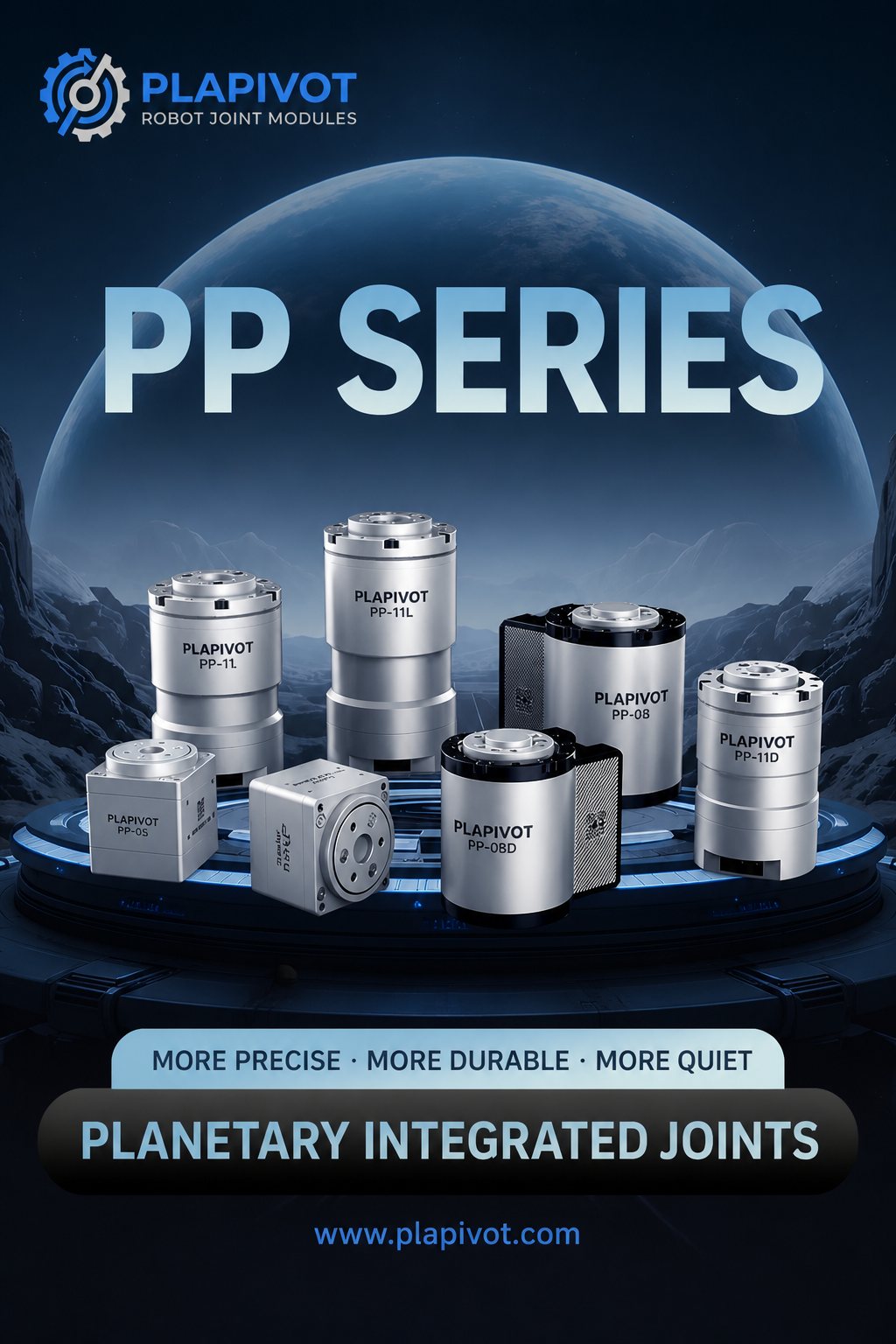
The PP planetary series: six integrated joint modules from 0.2 to 10 Nm.
1. A New Addition to the PlaPivot Family
Until now, PlaPivot's catalog has centered on harmonic-drive rotary joint modules from 2.4 to 420 Nm — the right choice for industrial precision. But humanoid robotics, education platforms and budget automation projects have a different profile: compact dimensions, light weight, low cost, and joints that can absorb occasional impacts without damage. That is exactly the niche the PP planetary series fills.
The series keeps the integrated-module concept our customers rely on — motor, gearbox, dual encoders and communication in one sealed unit — while swapping the harmonic drive for a precision planetary gearbox. The result is a compact integrated servo joint family that is more impact-tolerant and more affordable, at a backlash level (≤12 arcmin) that is entirely adequate for the applications below.
2. The Model Lineup
Six models span rated torques from 0.2 to 10 Nm, all at 24 V with 50 RPM rated speed and CAN 2.0 control:
| Model | Diameter | Length | Weight | Ratio | Max Power | Rated Torque | Peak Torque |
|---|---|---|---|---|---|---|---|
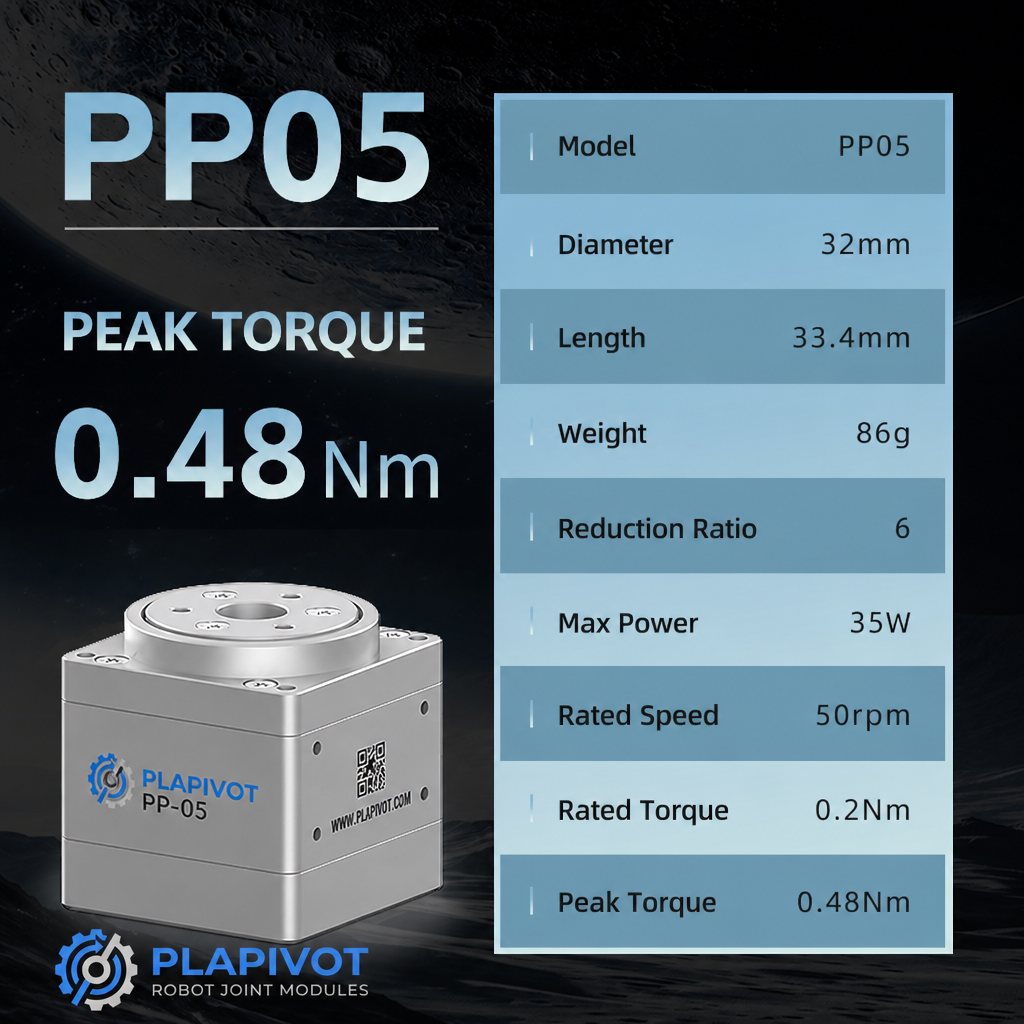
| PP-05 | 32 mm | 33.4 mm | 86 g | 6 | 35 W | 0.2 Nm | 0.48 Nm |
| PP-08 | 40 mm | 52 mm | 189 g | 36 | 36 W | 1.0 Nm | 2.2 Nm |
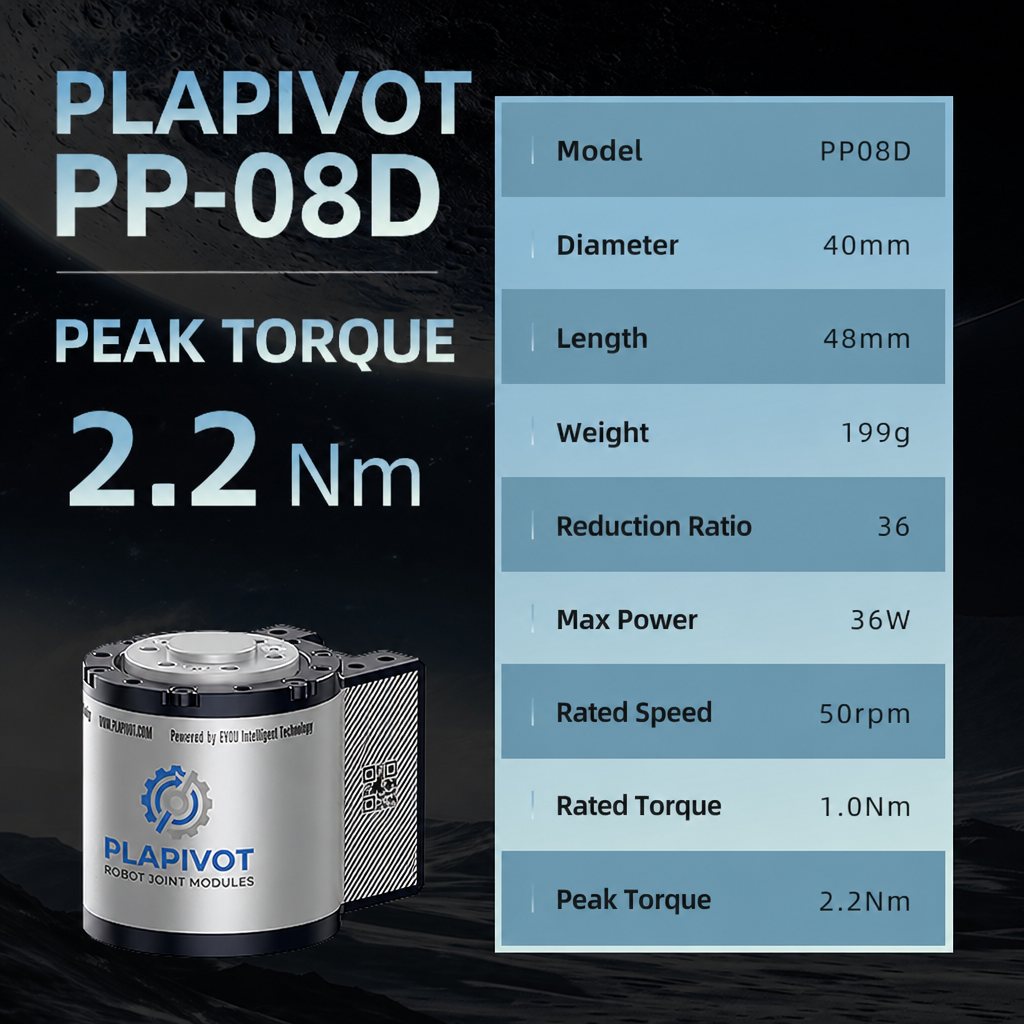
| PP-08D | 40 mm | 48 mm | 199 g | 36 | 36 W | 1.0 Nm | 2.2 Nm |
| PP-11 | 52 mm | 64 mm | 390 g | 36 | 60 W | 6.6 Nm | 10 Nm |
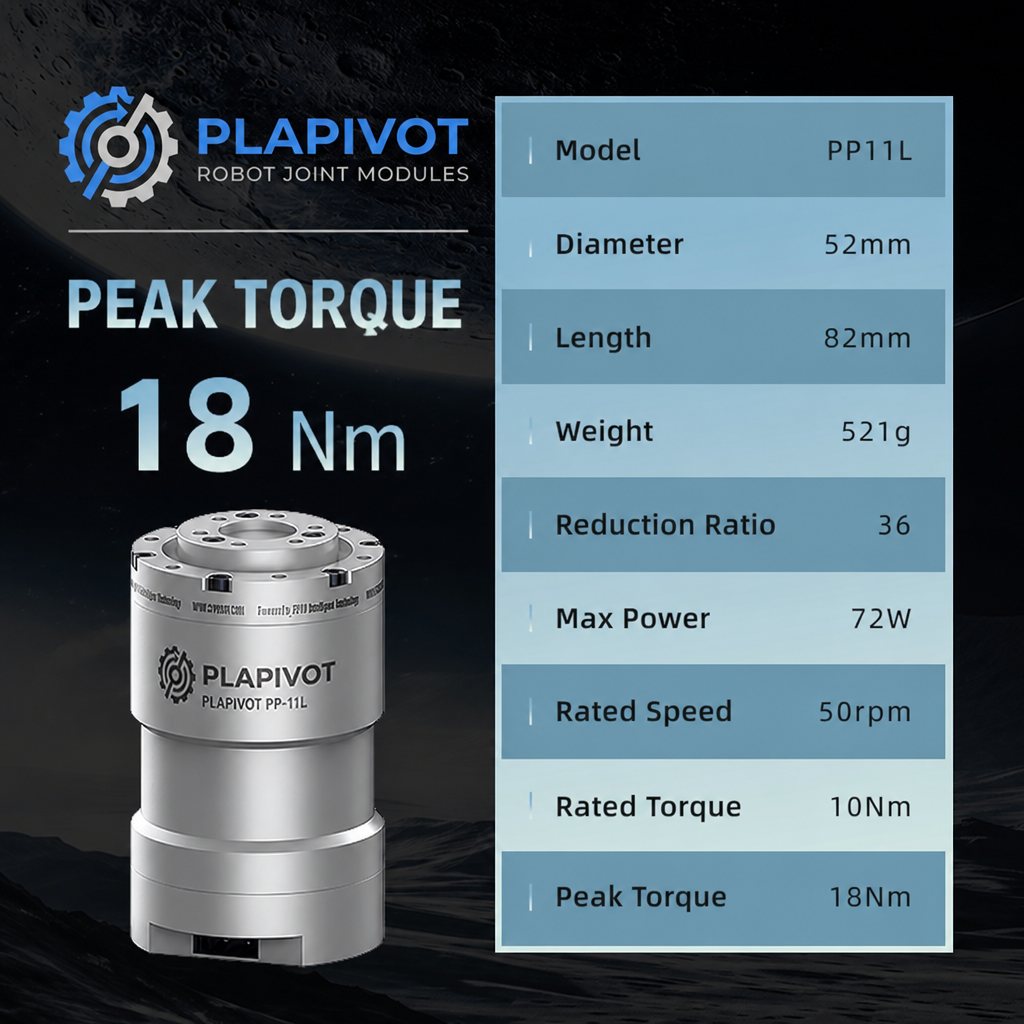
| PP-11L | 52 mm | 82 mm | 521 g | 36 | 72 W | 10 Nm | 18 Nm |
| PP-11D | 52 mm | 61 mm | 437 g | 36 | 60 W | 6.6 Nm | 10 Nm |
The D variants (PP-08D, PP-11D) use a shorter housing for the same torque — useful where axial space is the constraint. The PP-11L adds a longer motor section for the highest torque of the family.
3. What's Inside
The architecture follows the same proven layout as our larger modules, scaled down: a 4-point contact bearing supports the output, a precision planetary gearbox delivers the reduction, a frameless torque motor drives the input at high power density, and dual absolute encoders report true output position without homing. Communication runs over a CAN 2.0 bus with hardware FOC drive for smooth torque output.
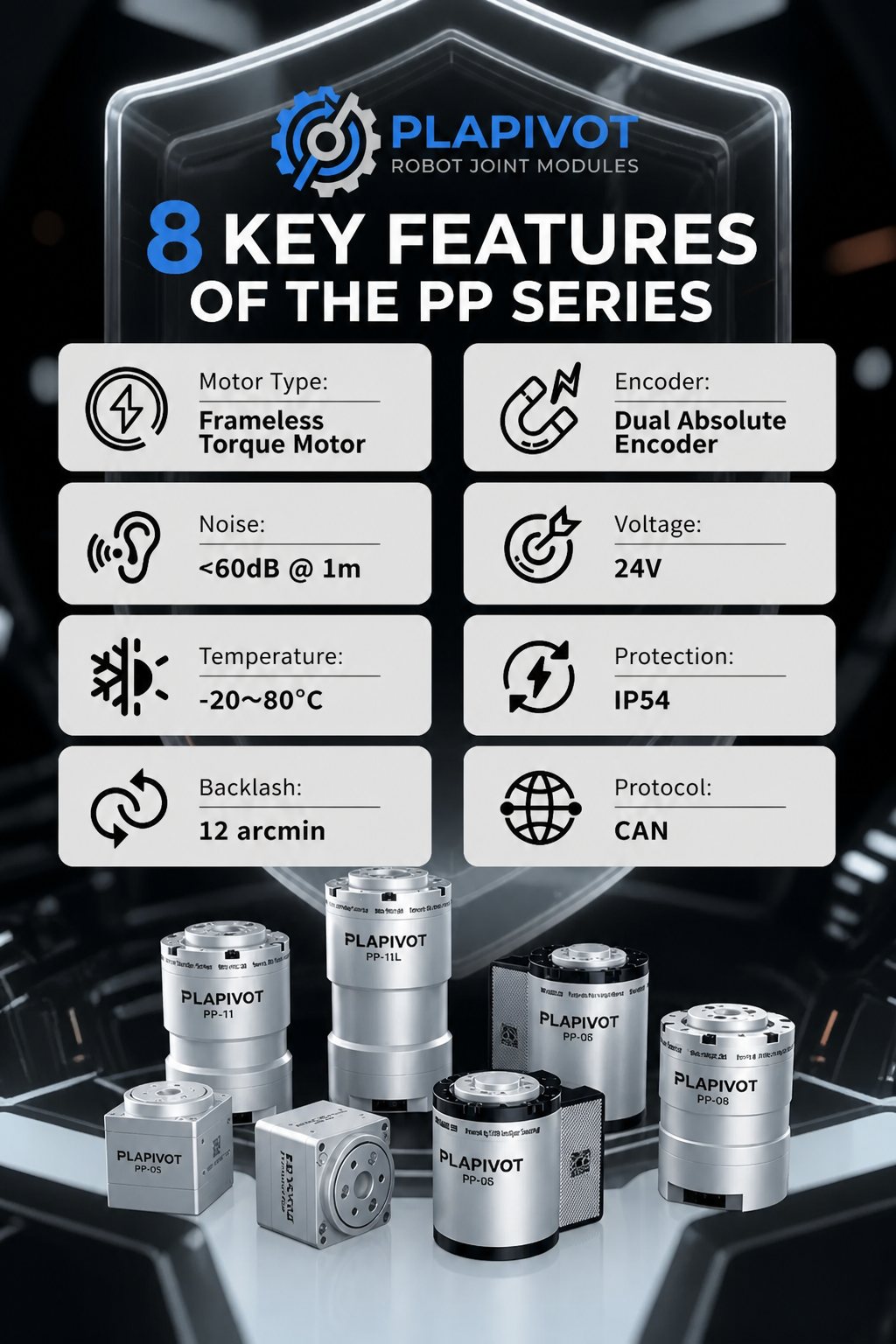
4. Series-Level Specifications
| Parameter | Value |
|---|---|
| Operating voltage | 24 V DC |
| Protection rating | IP54 |
| Motor type | Frameless torque motor (high power density) |
| Reducer | Precision planetary gearbox (ratio 6 or 36) |
| Feedback | Dual absolute encoders |
| Communication | CAN / CAN 2.0 bus |
| Backlash | ≤12 arcmin |
| Noise | <60 dB @ 1 m |
| Operating temperature | −20 to +80 °C |
| Bearing | 4-point contact bearing |
5. Where the Planetary Series Shines
- Humanoid robots: the wrists, fingers and lower-torque joints of a humanoid need many small, light modules — see our humanoid joint guide for the full joint map. PP-05 (86 g) and PP-08 (189 g) are sized for exactly these positions.
- Small robotic arms & desktop robots: a 4–6-axis arm for research, bench automation or inspection fits entirely within this torque range.
- Education & STEM: the low entry price and simple CAN control make the series practical for university labs and robotics courses. Our education joint guide covers the selection logic.
- Motion control & orientation platforms: pan-tilt heads, camera gimbals and small turntables.
- Prosthetics & exoskeletons: light weight and 24 V battery compatibility suit wearable applications.
6. Planetary vs Harmonic: Which Do You Need?
| Factor | Harmonic series (PP-52L…PP-170P) | Planetary series (PP-05…PP-11D) |
|---|---|---|
| Backlash | <1 / <0.5 arcmin | ≤12 arcmin |
| Precision positioning | Excellent | Good for most applications |
| Impact tolerance | Moderate | Higher (tooth-to-tooth engagement) |
| Size / weight | Compact | Extremely compact (86 g smallest) |
| Voltage / bus | 48 V, EtherCAT/CANopen | 24 V, CAN 2.0 |
| Best for | Industrial precision, higher torque | Humanoids, education, budget builds |
For a deeper comparison of reducer technologies, our reducer comparison guide explains the mechanical trade-offs.
7. Wiring and Control Notes
- All models run on a single 24 V DC bus with CAN 2.0 signal lines; the modules are configured and tuned over the CAN bus.
- Supporting accessories are available: planetary communication/daisy-chain cables (XT30PW), power-communication splitter boards (one-to-four), and connection adapters.
- For integration questions, our CANopen protocol guide covers the bus-level details your controller needs.
8. Getting Started
The fastest way to evaluate the series is to order a single module, build a one-axis test rig and confirm your controller integration before scaling to a full arm — the same low-risk path we recommend in our small-batch guide. Datasheets, CAD models and CAN protocol documents are available on request.
Building a Robot with the PP Series?
Tell us your joint map and controller — we'll confirm compatibility, send datasheets and CAD models, and quote within 24 hours.
Request Quote & Datasheet