Executive Summary
Harmonic drive reducers deliver <1 arc-minute backlash and excel in precision cobots, surgical robots, and applications where positioning accuracy is non-negotiable. Planetary gear reducers cost 40-60% less but carry 3-8 arc-minutes of backlash. For ISO-compliant collaborative robots, harmonic drive is the industry standard.
1. Why the Reducer Matters
The reducer is the heart of every robot joint module. It multiplies motor torque, determines stiffness and backlash, and dominates the module's cost (typically 30–45% of BOM). Choosing between harmonic drive and planetary gear is arguably the most consequential design decision in cobot arm development.
A poor reducer choice means your robot arrives at the commanded position slightly off, every single cycle. Over a 500mm reach, 3 arc-minutes of backlash translates to ~0.44mm of positional uncertainty at the end effector — invisible to the human eye, but devastating for precision assembly or surgical tasks.
2. Head-to-Head Comparison
| Parameter | Harmonic Drive | Planetary Gear | Winner |
|---|---|---|---|
| Backlash | <1 arc-min | 3–8 arc-min | Harmonic |
| Torque Density | 80–100 Nm/kg | 40–60 Nm/kg | Harmonic |
| Stiffness | High (steel flexspline) | Moderate | Harmonic |
| Efficiency | 70–85% | 85–94% | Planetary |
| Gear Ratio (Single Stage) | 50:1–160:1 | 3:1–10:1 | Harmonic |
| Noise Level | Very low (<55 dB) | Moderate (60–70 dB) | Harmonic |
| Service Life (L10) | 10,000–20,000 hrs | 5,000–10,000 hrs | Harmonic |
| Unit Cost (50–150Nm) | $400–$1,500 | $150–$600 | Planetary |
| Backdrivability | Good | Moderate to poor | Harmonic |
| Shock Load Handling | Moderate | Good | Planetary |
Harmonic Drive (left) vs Planetary Gear (right) — two fundamentally different approaches to torque transmission.
3. How Harmonic Drive Works
A harmonic drive uses three concentric components: a wave generator (elliptical ball bearing on the motor shaft), a flexspline (thin-walled flexible steel cup with external teeth), and a circular spline (rigid ring with internal teeth).
As the wave generator rotates, it deforms the flexspline, engaging teeth at two opposing points with the circular spline. Because the flexspline has 2 fewer teeth than the circular spline, one full wave generator rotation advances the output by exactly 2 teeth — yielding ratios from 50:1 to 160:1 in a single stage with zero backlash.
This is why harmonic drive robot joint modules dominate the cobot market: no clearance, no dead zone, no positional drift over time. The engagement is pure elastic deformation, not sliding contact.
4. How Planetary Gear Works
A planetary gearset consists of a central sun gear, multiple planet gears mounted on a carrier, and an outer ring gear with internal teeth. Torque is distributed across 3–5 planet gears simultaneously, giving excellent load sharing and shock tolerance.
However, planetary gears inherently have clearances between meshing teeth. Even precision-ground planetary sets (ISO 5-6 class) carry 3–5 arc-minutes of backlash. This is acceptable for material handling, palletizing, or low-precision pick-and-place — but inadequate for tasks requiring sub-millimeter repeatability.
Planetary reducers are often chosen for lower-cost servo joint modules in non-collaborative applications, or as a cost-cutting measure on axes where precision matters less (e.g., auxiliary rotation stages).
Applications requiring sub-arcminute precision benefit from harmonic drive's near-zero backlash.
5. Application Decision Matrix
| Application | Backlash Requirement | Recommended Reducer | Example Module |
|---|---|---|---|
| 6-axis Cobot Arm (ISO 10218) | <1 arc-min | Harmonic Drive | PP-100S 30Nm |
| Surgical Robot | <0.5 arc-min | Harmonic Drive | PP-065S 6Nm |
| AGV Steering Unit | 5–10 arc-min | Planetary (or Harmonic) | PP-085S 15Nm |
| Palletizing Robot J1-J3 | <2 arc-min | Harmonic Drive | PP-170S 150Nm |
| Lab Automation Positioner | <1 arc-min | Harmonic Drive | PP-065S 6Nm |
| Conveyor Diverter | 5–15 arc-min | Planetary | N/A |
6. The Integration Factor
Beyond the reducer itself, there's an important secondary consideration: how well is it integrated? A standalone harmonic drive reducer still requires you to source a motor, align the wave generator, design a housing, mount encoders, and tune the servo — easily 3–6 months of engineering work.
An integrated harmonic drive actuator like PlaPivot's PP-series bundles the reducer with a frameless torque motor, dual 23-bit absolute encoders, and servo driver into one IP65-sealed unit. You mount it, plug in EtherCAT or CANopen, and it runs — with factory-tested torque-speed curves and backlash data ready for your compliance documentation.
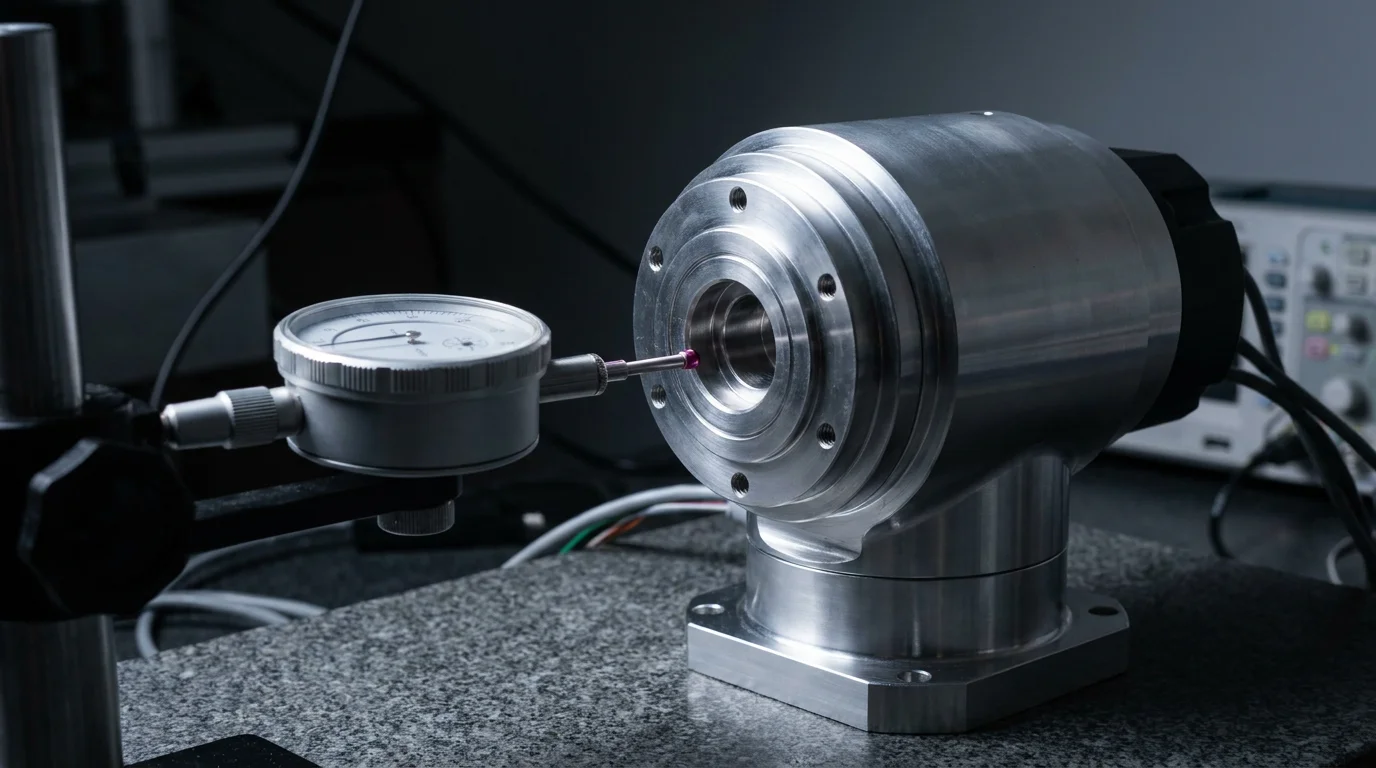
The <0.5 arcmin backlash of precision harmonic drives is invisible to the naked eye but critical for accuracy.
7. Cost Analysis: Component vs Integrated
| Approach | Cost per Joint (30Nm) | Engineering Time | Risk |
|---|---|---|---|
| DIY (harmonic drive + motor + encoder + driver) | $900–$1,200 (BOM) | 12–24 weeks | High (alignment, tuning) |
| Integrated harmonic drive joint module | $1,100–$1,500 | 1–2 days | Low (factory-tested) |
| DIY planetary gear + motor | $400–$600 | 8–16 weeks | Medium |
The BOM cost of an integrated module is about 15–25% higher than sourcing components yourself, but the engineering time saved typically pays for the difference in the first month of a cobot development project. When you factor in reduced testing, compliance documentation, and ongoing support from a single robot joint module manufacturer, the total cost of ownership strongly favors integrated harmonic drive modules.
8. The Verdict
- Choose Harmonic Drive If: You're building a precision cobot, surgical robot, or any application requiring <1 arc-min backlash, smooth backdrivability, or ISO 10218 compliance. This is 85%+ of the cobot market.
- Choose Planetary Gear If: Your application tolerates 3+ arc-minutes of backlash, cost is the dominant factor, and positioning accuracy is secondary (e.g., simple rotary indexers, non-collaborative low-precision axes).
- Don't Mix Reducer Types in One Arm: Using harmonic on J1-J3 and planetary on J4-J6 creates inconsistent dynamics that complicate your control software and degrade path accuracy.
Want to discuss your specific application? Contact PlaPivot's engineering team. We'll help you select the right harmonic drive robot joint module for your cobot design.
Need Harmonic Drive Joint Modules?
PP-series: 6Nm-150Nm. EtherCAT/CANopen. CE certified. Request a quotation today.
Request Quote & Datasheet