Designing a humanoid robot is the ultimate challenge in mechatronics. Unlike industrial robots that are bolted to a floor, humanoids must be lightweight, perfectly balanced, and capable of high-torque 'bursts' for walking and lifting. The joint modules used in the shoulders, elbows, and wrists of a humanoid must meet a unique set of constraints that separate them from standard industrial actuators.
1. Shoulder Design: 3 Degrees of Freedom in a Tight Space
A human-like shoulder requires 3 axes of motion (Pitch, Roll, and Yaw) to converge at a single point to mimic the ball-and-socket joint of a human. This is incredibly difficult to achieve with traditional motors and gearboxes. Modern humanoid designers use 'tapered' joint modules to solve this. A large, high-torque module (like the PP-100) handles the heavy lifting of the 'Pitch' and 'Roll' axes, while a smaller, lighter module (like the PP-65) handles the 'Yaw' or arm rotation. The high torque-to-weight ratio of PlaPivot modules is vital here; every extra gram in the shoulder requires more power from the 'hip' and 'ankle' joints to maintain balance during dynamic movement. Optimizing shoulder mass is the first step in building a humanoid that doesn't fall over during its first step.
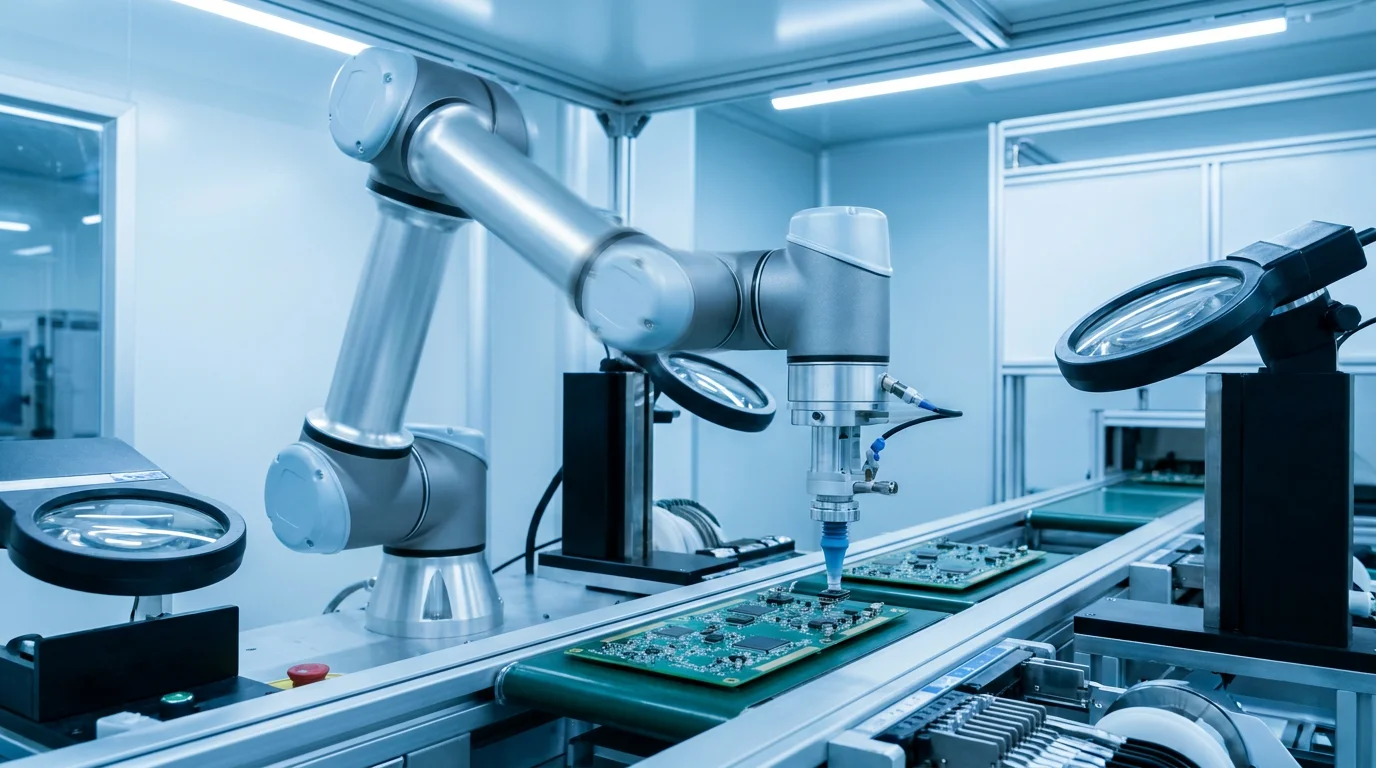
Figure: Technical implementation of Robot Joint Modules for Humanoid Robots: Shoulder, Elbow and Wrist Design. High-precision components for reliable robotic motion.
2. The Elbow: Balancing Strength and Speed
The elbow joint must be strong enough to lift a payload (like a box or a tool) but fast enough for natural, human-like gestures. It also needs to be 'back-drivable' if the humanoid is designed to interact safely with people in unconstrained environments. Our PP-80S module is a favorite for humanoid elbows because it offers a large hollow shaft for routing all the wrist and finger cables through, while providing enough torque to curl a 5kg load. The integrated absolute encoders also ensure that the robot 'knows' its arm position instantly upon wake-up, preventing the dangerous 'flailing' that can happen with incremental systems. High-frequency velocity control in the elbow is what gives humanoid arms their lifelike 'damped' motion.
3. Humanoid Wrists: The Need for Extreme Compactness
The wrist is the most crowded part of a humanoid arm. It needs to be small enough to fit inside a human-sized forearm skin but powerful enough to move a complex multi-fingered hand. We recommend our 'Ultra-Slim' PP-series modules for this application. These modules sacrifice some peak torque for a significantly shorter axial length, allowing them to be 'nested' together to create a compact, 2-axis wrist. This compactness is what allows humanoids to reach into tight spaces and perform delicate manipulation tasks like opening doors, picking up tools, or typing on a keyboard. A smaller wrist also reduces the rotational inertia of the entire arm, making high-speed reactions possible.
Figure: Technical implementation of Robot Joint Modules for Humanoid Robots: Shoulder, Elbow and Wrist Design. High-precision components for reliable robotic motion.
4. Transparency and 'Proprioception'
A humanoid shouldn't just follow a path; it should 'feel' the world. This is called proprioception. High-quality joint modules allow for 'current-mode' control, where the controller specifies the *force* (torque) rather than the position. This allows the humanoid to 'give' when it hits a wall or to shake a human's hand with just the right amount of pressure. Achieving this 'transparency' requires extremely low internal friction in the harmonic drive and high-frequency current loops (20kHz+) in the integrated driver. All PlaPivot modules support this advanced force-control mode, providing the 'intelligence' needed for the next generation of bipedal and humanoid robots. This tactile feedback is essential for tasks like 'blind' manipulation where the robot cannot see the object it is holding.
5. Energy Efficiency for Untethered Operation
Most humanoids are designed to run on battery power. Therefore, every watt of energy wasted as heat in a joint is a minute of battery life lost. PMSM-based joint modules with high-efficiency gear reducers are the only viable choice for untethered humanoids. PlaPivot's PP-series uses high-performance magnets and optimized winding patterns to achieve over 90% motor efficiency. Furthermore, the ability to 'regenerate' energy during braking can be used to recharge the battery slightly during downhill walking or arm-lowering moves. For a 20-joint humanoid, these efficiency gains are the difference between a 30-minute runtime and a 2-hour runtime. Efficient joint selection is the key to moving humanoid robots from the lab into the real world.
Ready to start your build?
Our engineering team is ready to help you select the perfect robot joint modules for your application. Get expert advice and a custom quotation within 24 hours.
Get a Quote & DatasheetRelated articles you might find useful: