In 30 Seconds
In an ISO Class 5 cleanroom, a single worn seal or the wrong grease can shed enough particles to scrap an entire wafer lot. And the robot's joints — not its links, not its controller — are the main particle source in any cleanroom robot. This guide explains where particles come from in robot joint modules, what to demand from a datasheet, and how the PlaPivot PP-series maps to wafer handling, medical device assembly, and optics automation.
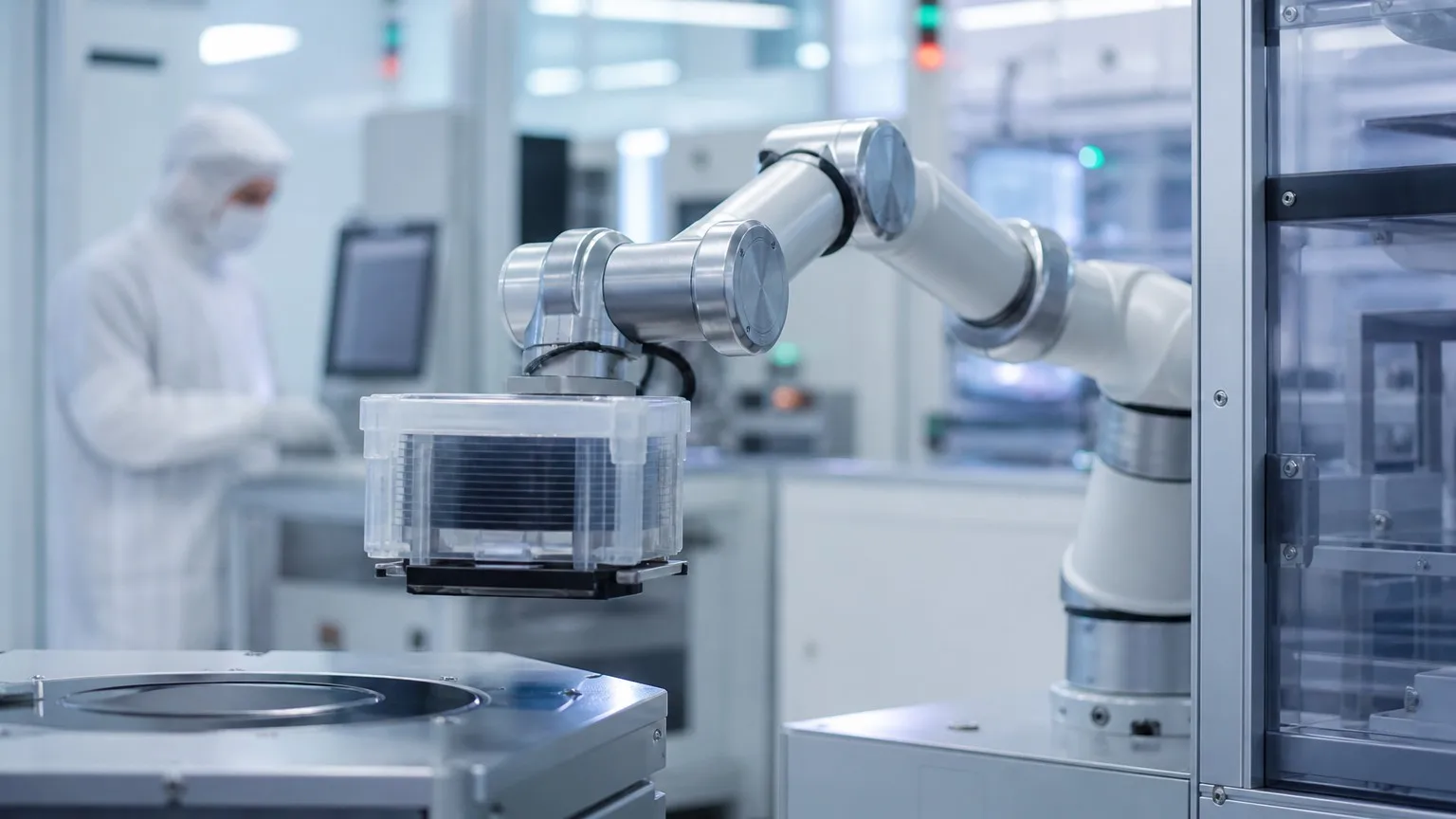
Cleanroom robots handle fragile, valuable payloads — every joint must stay clean and predictable.
1. Why Joints Are the Weak Point in Cleanroom Robots
A robot arm link is a piece of aluminum — it does not generate particles. The joints are different. Every rotation involves sliding seals, rolling bearings, and lubricant, and each is a potential contamination source:
- Dynamic seals — the rotary lip seal between the output flange and housing wears and sheds elastomer particles.
- Lubricant migration — grease that creeps out of the bearing race or gear mesh and volatilizes (outgassing) is one of the most common sources of molecular contamination in semiconductor fabs.
- Internal pressure "breathing" — as the joint rotates, the sealed internal volume changes slightly, pumping air and particles in and out through the seals with every cycle.
- Vibration-induced fretting — cogging or imbalance in the motor causes micro-motion at the bearing contact surfaces, generating metallic wear particles over time.
- ESD charging — non-conductive surfaces accumulate charge and attract particles; a charged arm becomes a particle magnet.
Cleanroom classification matters here. Under ISO 14644-1, an ISO Class 5 cleanroom (the standard for wafer processing) allows only 3,520 particles ≥0.5 µm per cubic meter. A joint that sheds a few particles per revolution can exceed that budget on its own.
2. Where Cleanroom Robots Work
Three industries dominate cleanroom robotics, and they stress joints differently:
| Application | Key Demands | Typical Joint Torque |
|---|---|---|
| Semiconductor: wafer handling, FOUP transfer, sorters | High speed, high precision, minimal particles, low height | 2–15 Nm |
| Medical device: syringe assembly, implant manufacturing, sterile packaging | Small footprint, smooth low-speed motion, cleanability | 2–15 Nm |
| Optics & photonics: lens alignment, sensor assembly | Sub-arc-minute positioning, zero vibration | 2–35 Nm |
Notice the common thread: cleanroom automation is dominated by light, precise, fast motion. The heavy end of a robot lineup rarely appears inside a cleanroom — payloads are small, and the valuable thing being handled is fragile, not heavy.
3. The Cleanroom Joint Module Checklist
When evaluating integrated joint modules for cleanroom duty, demand the following:
| Cleanroom Requirement | Why It Matters | Where to Find It |
|---|---|---|
| Sealed housing and ingress rating | Keeps lubricant in and particles out; reduces contamination risk | Confirm the ingress rating and cleanroom configuration for the selected model |
| Enclosed, internal lubrication | Harmonic drive flexspline cup keeps grease internal, minimizing outgassing surface | All PP-series (harmonic drive) |
| Absolute encoders (no homing) | No slow reference runs or hunting at startup; instant position memory | 17-bit dual absolute, all models |
| Smooth low-speed control | No cogging vibration → no fretting wear particles | Frameless torque motor + integrated driver |
| ESD-safe surfaces | Conductive path to ground prevents charge buildup | Anodized housing; confirm grounding with supplier |
| Hard, cleanable exterior | Survives wipe-down protocols without degrading | Hard-coat anodized aluminum; IP65 option |
| Sealed connectors | No exposed braid or vented gaps that collect particles | Integrated connector standard |
4. Semiconductor Example: FOUP Handling
A front-opening unified pod (FOUP) carrying 25 wafers weighs roughly 7–10 kg, and it must be transferred at arm reaches of 600–800 mm with settling times well under a second. The alignment tolerance at a load port is typically ±0.1 mm — which translates to a joint requirement of sub-arc-minute backlash and repeatability around ±0.003°.
For a 3–4 axis FOUP robot (vertical lift + two or three rotary axes), the PP-series maps cleanly:
- Vertical lift axis: start with a PP-20L linear joint module (880 N rated thrust, 69 mm stroke) when the mechanism requires direct linear motion; verify the complete lift load and duty cycle.
- Rotary wrist/roll axes: PP-08 and PP-11 provide compact current-series starting points for low-load rotary axes.
- Elbow/shoulder: PP-14 or PP-17, selected from the calculated torque, acceleration and settling-time requirement.
All models run on a 48 V DC bus and speak EtherCAT, which keeps the fab's control architecture uniform — one protocol for the robot, the load ports, and the conveyor system. For a deeper look at why absolute encoders are the right choice here, see Absolute vs Incremental Encoders.
5. Medical Device Assembly: Small, Precise, Quiet
Medical device lines add two constraints on top of cleanliness: small form factor and quiet operation. For compact cells, begin with the current PP-08 or PP-11 rotary modules and verify the final diameter, mass, noise and ingress configuration during quotation. The correct choice depends on the gripper load, link length and required settling time.
6. An Honest Note on Vacuum & Ultra-Clean
Standard PP-series modules are cleanroom-friendly by design (sealed, internal lubrication, no-homing absolute encoders), but they are not vacuum-rated out of the box. If your process demands UHV compatibility or ISO Class 1–3 (wafer processing chambers), the lubrication and connector spec must be customized — that is a conversation to have with our engineering team during quoting, not after the line is built.
Building a Cleanroom Automation Cell?
Tell us about your application and cleanroom class. We'll recommend modules, confirm sealing and lubrication suitability, and send CAD models and datasheets within 24 hours.
Request Quote & Datasheet