In the early days of robotics, 'homing' was a mandatory morning ritual. You'd power on the robot, and it would slowly move each joint until it hit a limit switch to 'find' its zero position. Today, thanks to absolute encoders, that's a thing of the past. But for many builders, the choice between absolute and incremental encoders—and understanding their various resolutions—is still a source of confusion.
1. Incremental Encoders: Simple but Limited
Incremental encoders work by counting pulses as the motor spins. They are cheap and offer high resolution, but they have a fatal flaw: they are 'amnesiacs.' If the power goes out, the encoder loses its count. In a robot, this is dangerous; the controller no longer knows where the arm is, which could lead to a collision upon restart. To use them safely, you need a 'homing' routine and often a battery-backed system to 'remember' the count during short outages. For modern professional robotics, incremental encoders are rarely used as the primary feedback for joint position.
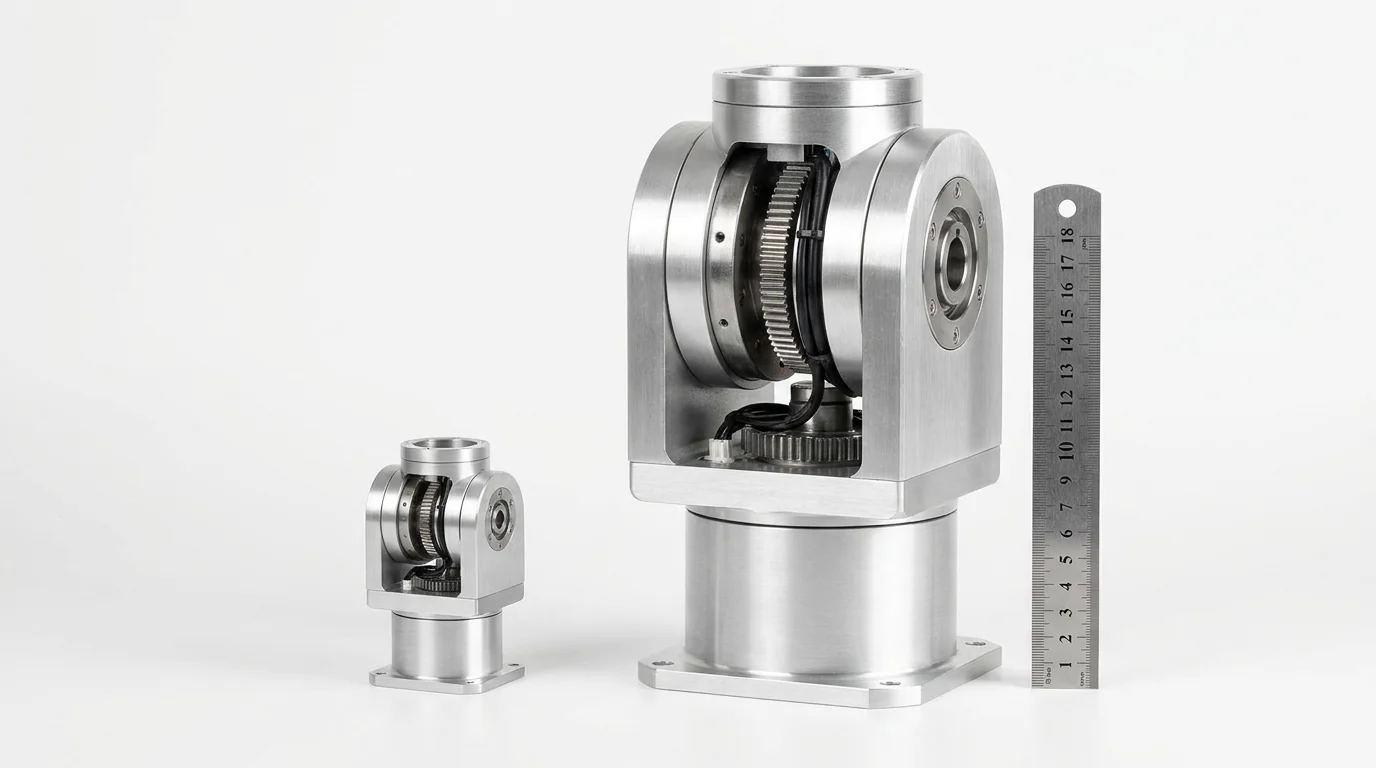
Technical illustration for Absolute vs Incremental Encoders: What Robot Builders Need to Know.
2. Absolute Encoders: The Modern Standard
Absolute encoders provide a unique digital code for every position of the shaft. They use optical or magnetic patterns that are permanent. When you turn the robot on, the controller reads the code and instantly knows the exact angle of the joint to within a fraction of a degree. Multi-turn absolute encoders (like those in our PP-series) go a step further by counting how many full rotations the joint has made, even when the power is off, using a small internal battery or a mechanical gear system. This 'instant-on' capability is a requirement for any collaborative robot that needs to resume a task immediately after an E-stop.
3. The Magic of Dual-Encoder Systems
Why do our joint modules have two encoders? It's all about the gearbox. Because a harmonic drive has a high reduction ratio (e.g., 100:1), the motor spins 100 times for every 1 rotation of the joint. By having an encoder on the motor, we get high-resolution feedback for smooth motor control. By having a second encoder on the *output* of the gearbox, we measure the actual position of the robot link. This eliminates errors caused by 'backlash' or the physical twisting of the gears under load. In professional robotics, this dual-loop control is what separates a shaky, inaccurate arm from a precise, industrial-grade manipulator.
Technical illustration for Absolute vs Incremental Encoders: What Robot Builders Need to Know.
4. Resolution: 18-bit vs 23-bit Explained
Encoder resolution is measured in 'bits.' An 18-bit encoder has 262,144 positions per turn, which sounds like a lot, but for a long robot arm, it might only equate to 0.1mm of accuracy at the tip. A 23-bit encoder, which is standard in PlaPivot's high-precision modules, has 8,388,608 positions. This level of 'granularity' allows the servo driver to detect even the tiniest vibrations or movements, leading to incredibly smooth motion and the ability to perform 'force sensing' without expensive external sensors. When building a robot for delicate tasks like surgery or micro-assembly, 23-bit output-side resolution is the industry benchmark.
Ready to start your build?
Our engineering team is ready to help you select the perfect robot joint modules for your application. Get expert advice and a custom quotation within 24 hours.
Get a Quote & DatasheetRelated articles you might find useful: