In high-precision robotics, 'smoothness' is just as important as speed or power. Torque ripple—the periodic fluctuation in output torque as a motor rotates—is the enemy of smooth motion. It can cause visible vibrations in a robot's path, leading to poor surface finishes in milling or uneven beads in welding. Understanding the physics behind torque ripple and the strategies to eliminate it is vital for any robot designer.
The Physics of Cogging and Flux Harmonics
Torque ripple in the motor itself comes from two primary sources: cogging torque and harmonic distortion in the magnetic flux. Cogging torque is the 'notchy' feeling you get when turning a permanent magnet motor by hand; it's caused by the magnets' attraction to the steel teeth of the stator. Flux harmonics occur because the magnetic field is never a perfect sine wave. In PlaPivot joint modules, we use 'skewed' stator designs and optimized magnet shapes to naturally cancel out these effects, providing a much smoother baseline than standard industrial motors.
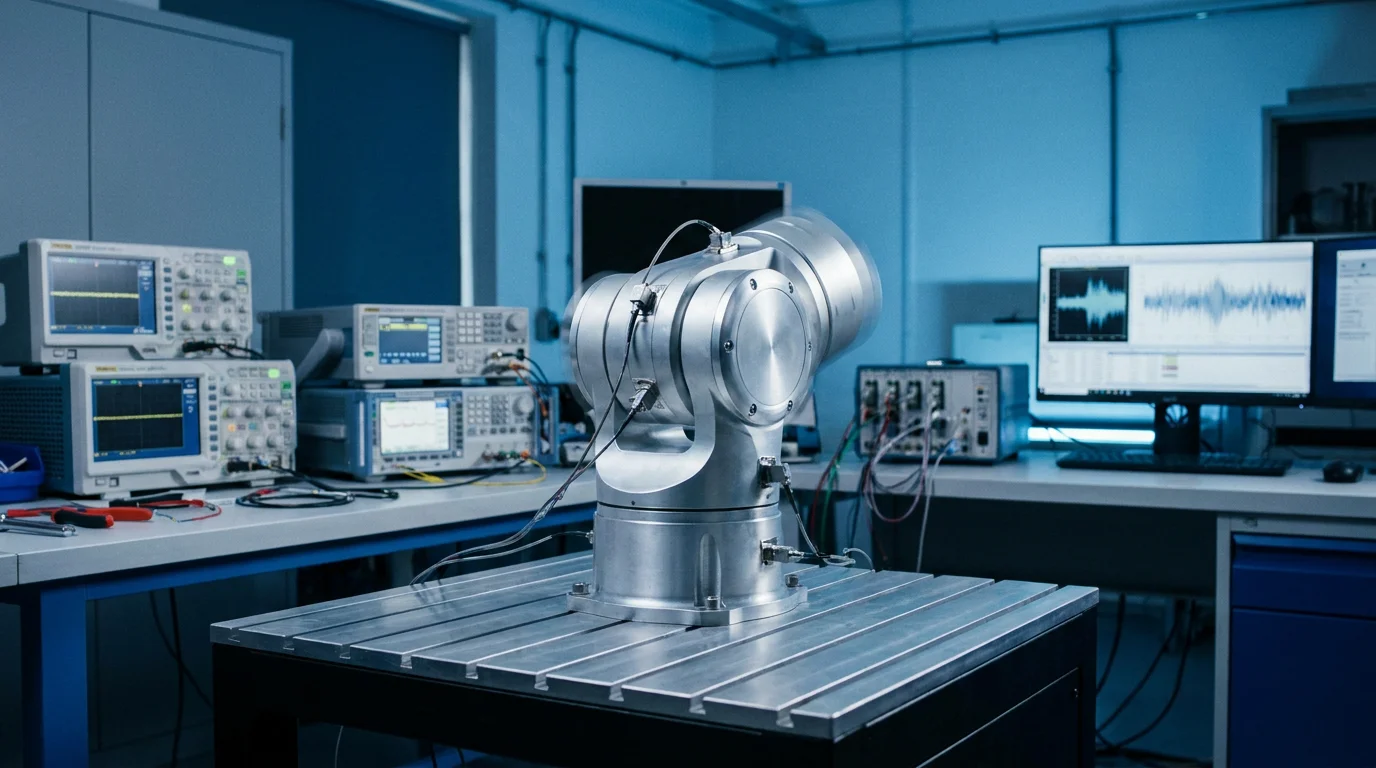
Technical illustration for Torque Ripple in Robot Joints: Causes, Impact and Mitigation.
The Gearbox Contribution: Harmonic Fluctuations
While the motor is often blamed, the gearbox also contributes to torque ripple. In a harmonic drive, the flexible spline deforms slightly as it rotates, creating a tiny 'wave' in the output torque. This is often referred to as 'transmission error.' While it's impossible to eliminate entirely in a mechanical system, using high-precision gear components with controlled elastic properties helps reduce the amplitude of these ripples. Our R&D focuses on the lubrication and surface finish of the wave generator to ensure consistent torque delivery.
Impact on Precision and Surface Finish
Why does this matter? If you are using a robot for 3D printing or laser cutting, any vibration caused by torque ripple will show up as a pattern on the final product. In force-controlled applications, such as robotic massage or collaborative assembly, torque ripple can be felt as a 'buzz' or 'roughness' by the human user. It also makes the PID tuning more difficult, as the controller has to constantly fight against these internal disturbances to maintain a steady speed.
Technical illustration for Torque Ripple in Robot Joints: Causes, Impact and Mitigation.
Mitigation via Field Oriented Control (FOC)
Modern electronics provide a powerful tool for fighting torque ripple: advanced Field Oriented Control. By measuring the current at very high frequencies (up to 25kHz), the servo driver can apply 'anti-ripple' compensations in real-time. If the driver knows exactly where the motor is in its rotation, it can slightly increase or decrease the current to counteract the known cogging points. PlaPivot's embedded drivers feature pre-calibrated torque ripple maps that are unique to each motor-gearbox combination.
Choosing the Right Module for Smoothness
Not all joint modules are created equal when it comes to torque ripple. For applications requiring the highest level of smoothness, look for modules with higher encoder resolution and specialized motor winding patterns. Our 'Precision Series' is specifically designed for low-ripple performance, making it the preferred choice for medical robotics and high-end manufacturing. Always ask your supplier for a 'Torque Ripple Plot' if your application depends on ultra-smooth velocity control.
Ready to start your build?
Our engineering team is ready to help you select the perfect robot joint modules for your application. Get expert advice and a custom quotation within 24 hours.
Get a Quote & DatasheetRelated articles you might find useful: