When a robot needs to lift heavy automotive parts, stack pallets, or perform high-force machining, 'standard' actuators simply won't cut it. Heavy-payload robotics requires a different class of joint modules—ones designed for massive torque, extreme structural rigidity, and long-term thermal stability. In this guide, we explore the engineering behind our 100Nm+ actuators and how to select the right one for your heavy-duty application.
The Torque Equation: Gear Ratios and Motor Size
To achieve 100Nm of continuous torque in a compact package, the relationship between the motor and the gearbox must be perfectly optimized. Typically, this involves using a high-reduction harmonic drive (100:1 or 120:1) paired with a high-pole-count PMSM motor. At these torque levels, the internal stresses on the flexible spline are immense. PlaPivot's RHA-32 and RHA-40 series utilize reinforced gear teeth and aerospace-grade steel to ensure that the gearbox doesn't just provide torque, but does so reliably over millions of cycles.
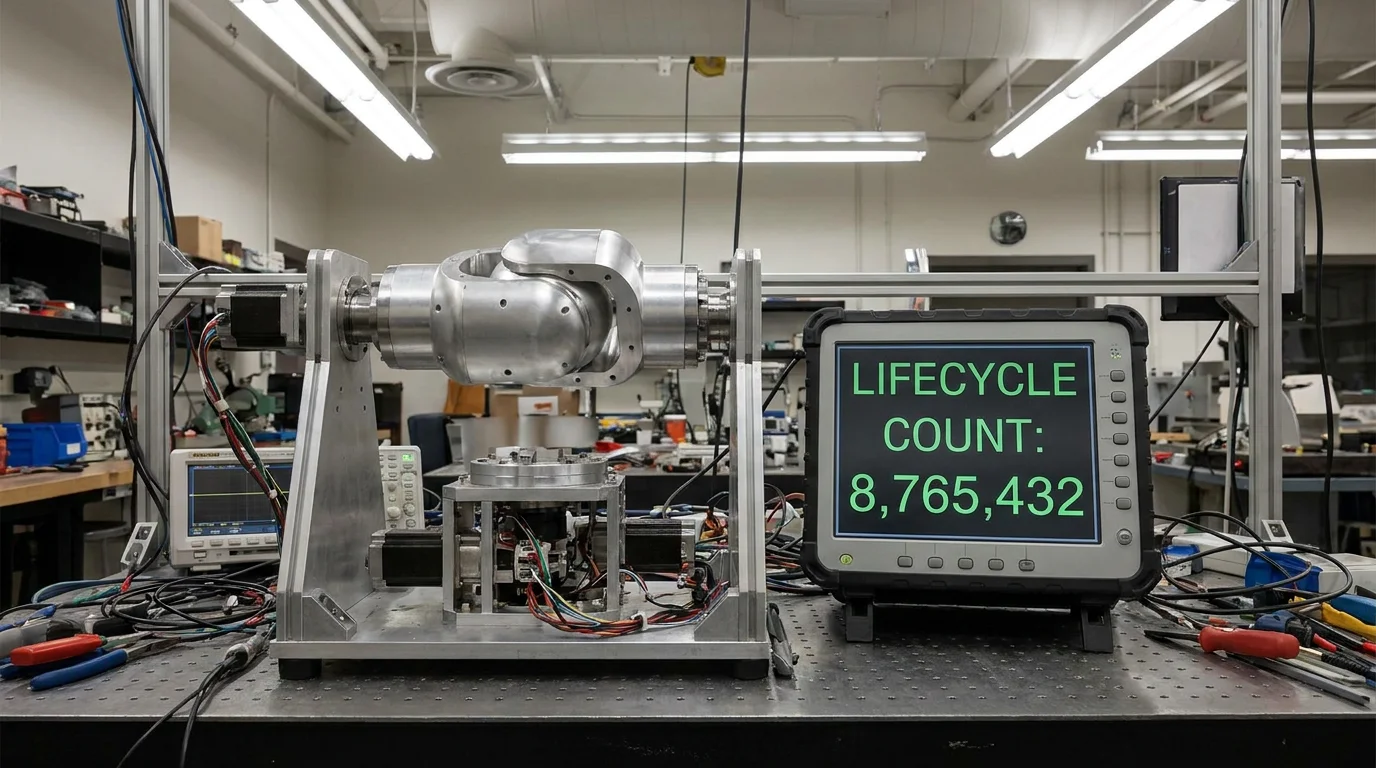
Technical illustration for Heavy Payload Robot Joint Modules: 100Nm+ Actuator Selection Guide.
Structural Integrity and Moment Load Capacity
It's not just about the spinning torque; it's about the 'tilting' force. A heavy arm extended 1.5 meters creates a massive lever effect on the base joint. This is known as the 'moment load.' Heavy-duty modules must incorporate large-diameter cross-roller bearings to support these forces without deforming. Our heavy-payload series is designed with a high safety factor, ensuring that the module can handle simultaneous axial, radial, and moment loads while maintaining arc-second precision.
Thermal Management for Continuous Operation
High torque equals high heat. In industrial applications where a robot might be moving 24/7, heat dissipation becomes the limiting factor. Our 100Nm+ modules feature integrated thermal sensors and finned aluminum housings that act as a giant heat sink. For the most demanding applications, we offer liquid-cooled mounting plates that can pull heat away from the motor coils, allowing for higher continuous duty cycles without risking demagnetization or insulation failure.
Technical illustration for Heavy Payload Robot Joint Modules: 100Nm+ Actuator Selection Guide.
Braking Systems for Heavy Loads
Safety is paramount when handling heavy payloads. If power is lost while a 50kg load is mid-air, the resulting crash could be catastrophic. Our heavy-duty modules come standard with high-torque electromagnetic brakes. These are 'fail-safe' brakes, meaning they are held open by power and snap shut instantly when power is removed. We also implement 'soft-stop' logic in our drivers to decelerate heavy loads smoothly even during a controlled stop, preventing sudden mechanical shocks to the gearbox.
Applications: From Palletizing to Construction
Where do these giants live? You'll find them in end-of-line palletizing systems, large-scale 3D printers for construction, and even in autonomous mining equipment. Any application where human-scale strength isn't enough, our high-torque modules provide the muscle. When selecting a module for these tasks, always look beyond the peak torque rating and consider the 'rated' or 'continuous' torque, as this is what determines the robot's actual work capacity over an 8-hour shift.
Ready to start your build?
Our engineering team is ready to help you select the perfect robot joint modules for your application. Get expert advice and a custom quotation within 24 hours.
Get a Quote & DatasheetRelated articles you might find useful: