The 'cable spaghetti' inside a robot arm is a major source of failure and a headache for designers. Single-cable technology is revolutionizing robot assembly by combining power and data into one simplified connection. This article explains how this technology works and why it is becoming the standard for modern robot joint modules.
The Evolution of Robot Wiring
Historically, connecting a robot joint required multiple cables: three thick wires for motor power, a bundle of thin wires for the encoder signal, and another set for the brake and thermal sensors. In a 6-axis robot, this resulted in a massive, heavy bundle of dozens of wires that had to be carefully routed through the joints. This 'umbilical cord' was prone to fatigue failure from constant bending, and the bulky connectors made miniaturization difficult. Single-cable technology solves this by using a single hybrid cable that carries everything—DC power, high-speed digital communication, and safety signals—in one compact package.
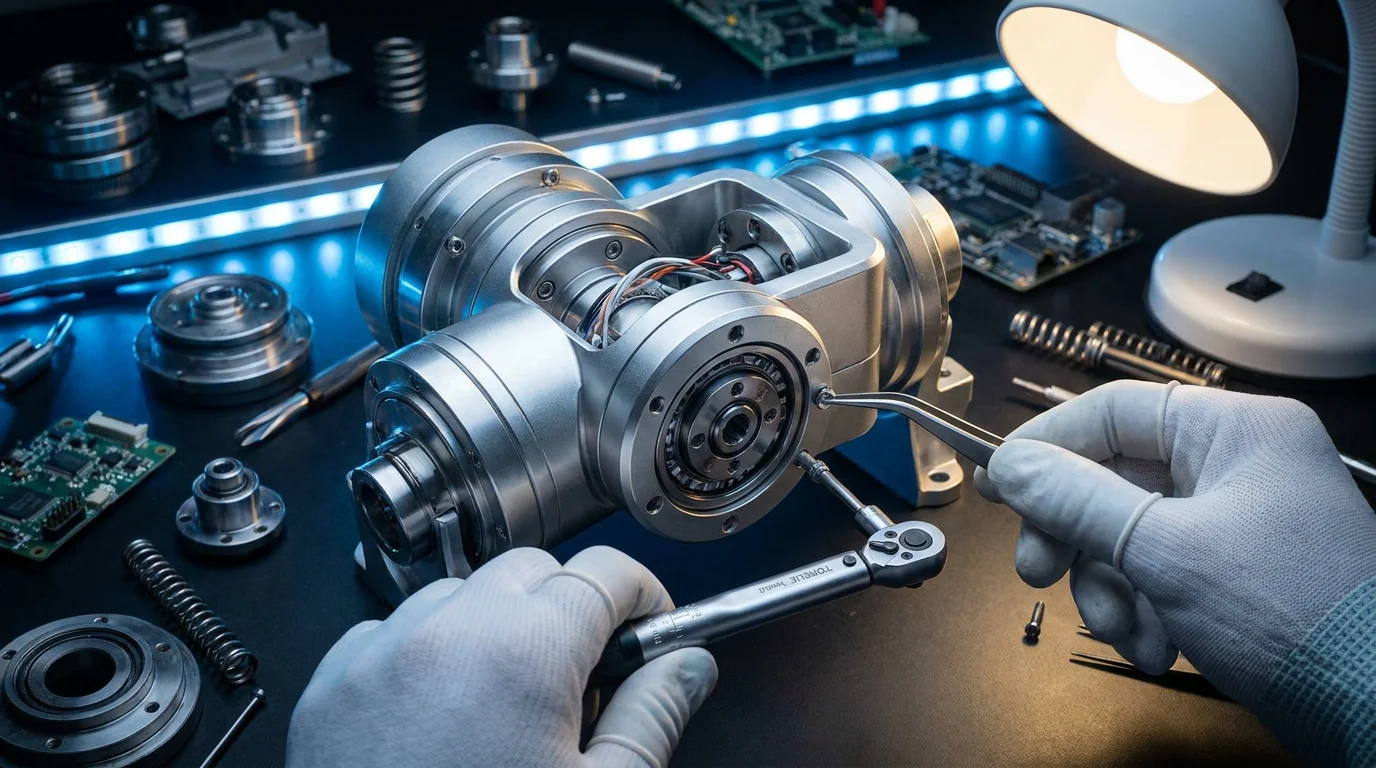
Technical illustration for Single-Cable Technology: How Robot Joint Modules Simplify Wiring.
How Power and Data Coexist on One Cable
Combining high-voltage power with sensitive data signals requires sophisticated engineering to prevent electromagnetic interference (EMI). Modern single-cable systems use highly shielded twisted pairs for data, or in some cases, 'Power over Data' techniques where the digital signal is modulated directly onto the power lines. For robot joint modules, the most common approach is a 'hybrid' cable design. These cables feature specialized insulation and shielding that allow 48V DC power and high-speed EtherCAT or CANopen data to travel side-by-side without the power surges from the motor 'noisy-ing' the delicate encoder feedback. This ensures reliable communication even during high-torque maneuvers.
Improving Reliability and Reducing Failure Points
In robotics, the connectors are often the weakest link. Every additional wire and pin is a potential point of failure due to vibration, oxidation, or improper seating. By moving from a multi-cable setup to a single-cable system, the number of connection points is reduced by up to 80%. This drastically improves the Mean Time Between Failures (MTBF) for the robot. Furthermore, single cables are specifically designed for high-flex applications, with specialized jackets and internal construction that can withstand millions of bending cycles. For end-users, this means less maintenance and fewer 'mysterious' communication errors that are often caused by failing wire strands.
Technical illustration for Single-Cable Technology: How Robot Joint Modules Simplify Wiring.
Enabling Hollow-Shaft and Sleek Designs
One of the biggest benefits of single-cable technology is that it enables more compact robot designs. Because the cable is so much thinner and more flexible, it can easily be routed through the 'hollow shaft' of the joint module. This 'internal routing' prevents the cables from getting snagged on external objects and allows the robot to perform complex rotations (such as those needed in 3D welding or painting) without the cables tangling. This results in robots that are not only more reliable but also much sleeker and more professional in appearance—a key requirement for collaborative robots and medical devices that work in close proximity to people.
Simplified Assembly and Maintenance for OEMs
For robot manufacturers (OEMs), single-cable technology is a game-changer for the production line. Assembling a robot arm becomes much faster when you only have to plug in one connector per joint instead of several. It also simplifies inventory management, as only one type of cable and connector needs to be stocked. In the field, troubleshooting is much easier; if a cable is suspected of being damaged, it can be replaced quickly without having to trace multiple separate wires through the robot's structure. This 'plug and play' simplicity is a major selling point for the next generation of modular robot components.
Ready to start your build?
Our engineering team is ready to help you select the perfect robot joint modules for your application. Get expert advice and a custom quotation within 24 hours.
Get a Quote & DatasheetRelated articles you might find useful: