Inspection robots go where humans can't: inside oil pipelines, at the bottom of the ocean, and into the radioactive heart of nuclear reactors. These environments place extreme demands on the joints that move the cameras and sensors. Inspection-grade joint modules must be compact, incredibly durable, and often specialized for specific environmental hazards.
Miniaturization for Confined Spaces
In pipeline inspection, size is everything. The robot must be able to navigate small-diameter pipes and tight turns. We design 'pancake' style joint modules that provide high torque in an extremely short axial length. By integrating the motor, gearbox, and driver into a single housing, we eliminate the need for external controllers, allowing for a much slimmer robot profile that can fit into 4-inch or 6-inch pipes.
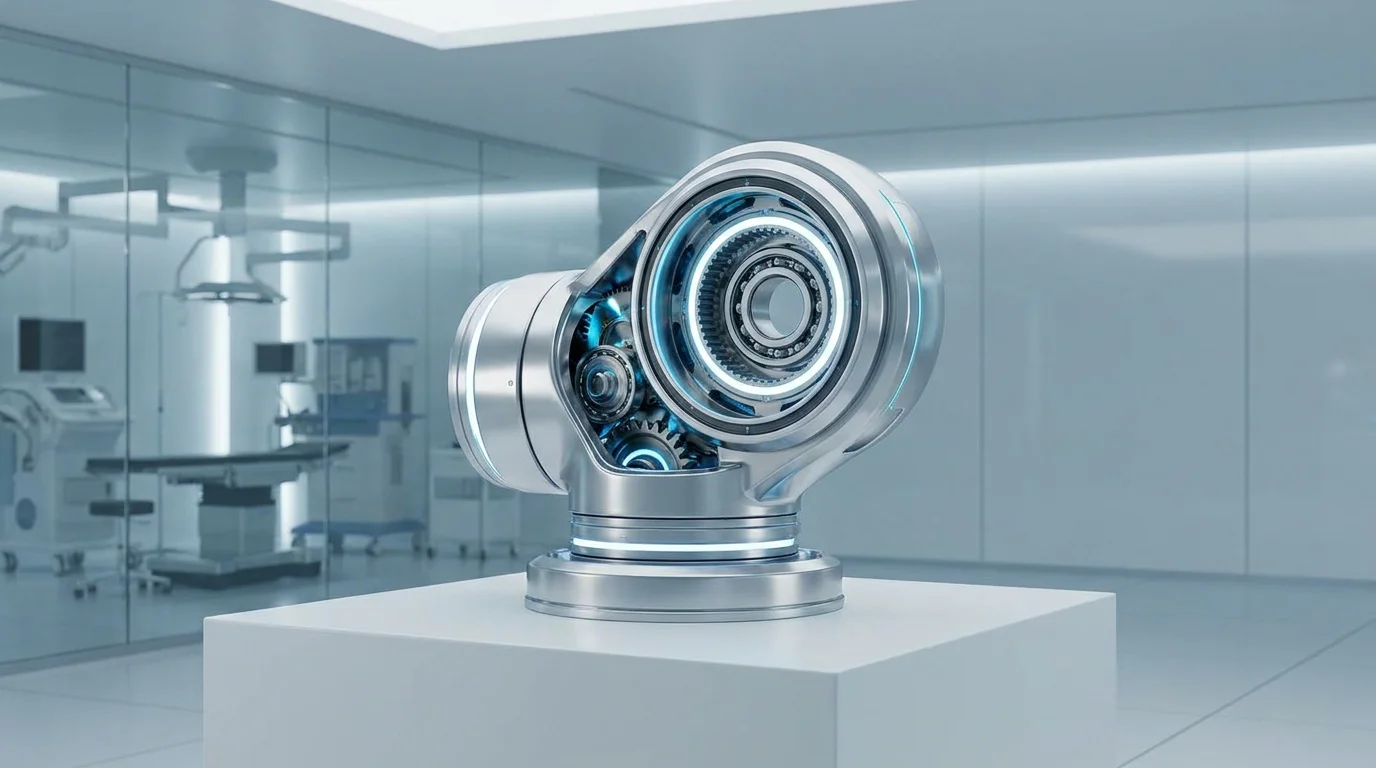
Technical illustration for Inspection Robot Joint Modules: Underwater, Pipeline and Confined Spaces.
Underwater and Pressure-Tolerant Design
For ROVs (Remotely Operated Vehicles) and subsea crawlers, joint modules must be pressure-compensated. Standard air-filled housings would collapse at depth. Instead, we fill the modules with non-conductive oil and use a bellows system to equalize internal and external pressure. Specialized rotary seals prevent the oil from leaking and seawater from entering, allowing our joints to operate at depths of up to 3,000 meters.
Radiation Hardening for Nuclear Inspection
Nuclear power plants require robots for routine inspection and decommissioning. High levels of gamma radiation can quickly destroy standard semiconductors and darken optical encoders. For these applications, we use radiation-hardened components and resolver-based feedback instead of optical encoders. The materials used in the seals and lubricants must also be selected for their resistance to radiation-induced degradation.
Technical illustration for Inspection Robot Joint Modules: Underwater, Pipeline and Confined Spaces.
High-Definition Feedback for Remote Sensing
Inspection is only as good as the data collected. If a robot is trying to identify a hairline crack in a structural weld, the camera must be held perfectly steady. Joint modules with high-resolution encoders and sophisticated vibration-dampening algorithms ensure that sensors are positioned with extreme stability, even if the robot platform itself is vibrating or moving in a current.
Tether Management and Low Power Consumption
Many inspection robots are tethered. Because long cables result in significant voltage drops, joint modules must be able to operate reliably across a wide input voltage range (e.g., 24V to 60V). Additionally, low power consumption is vital to prevent the tether from overheating and to allow for longer missions if the robot is battery-powered. Our integrated drivers are optimized for high-efficiency power conversion to meet these needs.
Sealing and Connector Strategy for Wet and Dusty Routes
Standard modules ship at IP54, which already covers dust and splash in most inspection tunnels; for flooded pipelines and subsea work the housing is upgraded to IP68 with pressure-compensated oil fill. In practice the weakest point is not the housing but the connector and cable entry. Specify overmolded cables, keep every connector on a single face of the module, and use strain relief rated for repeated bending — a snake-arm that cycles 10,000 bends will break an unterminated cable long before the gear wears out. For deep-water builds, choose wet-mate connectors so the robot can be unplugged and re-plugged at depth without drying the contacts.
Torque and Size Budget: A Worked Example for a Snake-Arm
Inspection arms are sized from the tool outward. Start with the camera head, then work back through each joint:
| Joint position | Model | Continuous torque | Weight | Why it fits |
|---|---|---|---|---|
| Camera pan/tilt wrist | PP-08 | 4.5 Nm | 0.16 kg | A 0.3 kg head at 0.15 m needs only ~0.4 Nm static; the module adds almost no mass to the arm tip |
| Elbow | PP-14 | 36 Nm | 0.7 kg | 2.5 kg of arm plus head at 0.45 m gives ~11 Nm static and ~20 Nm peak during pipe turns |
| Shoulder/base | PP-17 | 70 Nm | 1.1 kg | Full 6 kg arm at 0.6 m reach needs ~35 Nm static with 2× headroom for dynamic motion |
The math: static torque is mass × gravity × lever arm, and peak torque during a turn is roughly double the static figure on the harmonic PP-series. Sizing against continuous torque (not peak) with 20–30% headroom keeps the module out of thermal derating during long inspection passes.
Feedback and Telemetry Through the Tether
An inspection arm is only as useful as its positioning data. The 17-bit dual absolute encoders report true output position the moment power returns — no homing move required, which matters inside a dark pipe where there is no visible index mark. Over the tether, EtherCAT or CAN FD on the 48 V DC bus streams position, motor current and winding temperature back to the operator console, so a camera arm can hold a pose against a current while the surface team watches the joint temperature climb in real time. Combined with low-power hold modes, this keeps tether voltage drop and heat generation under control on 100–300 m cables.
Ready to start your build?
Our engineering team is ready to help you select the perfect robot joint modules for your application. Get expert advice and a custom quotation within 24 hours.
Get a Quote & DatasheetRelated articles you might find useful: