Choosing a robot joint module supplier is about more than just comparing specs on a datasheet. It's about finding a long-term partner who can support your engineering team throughout the product lifecycle. Before you place an order, ask these critical questions to vet your supplier and avoid expensive surprises down the road.
1. What is the actual MTBF and B10 life under my specific load?
Suppliers often quote life ratings under ideal, no-load conditions. Ask for data that matches your intended duty cycle and payload. A joint that lasts 20,000 hours at 50% load might fail in 2,000 hours at 90% load. Understanding the 'wear curve' of the gear system is essential for your maintenance planning.
Technical illustration for What to Ask Your Robot Joint Module Supplier Before Placing an Order.
2. Can you provide the full thermal model or duty cycle calculator?
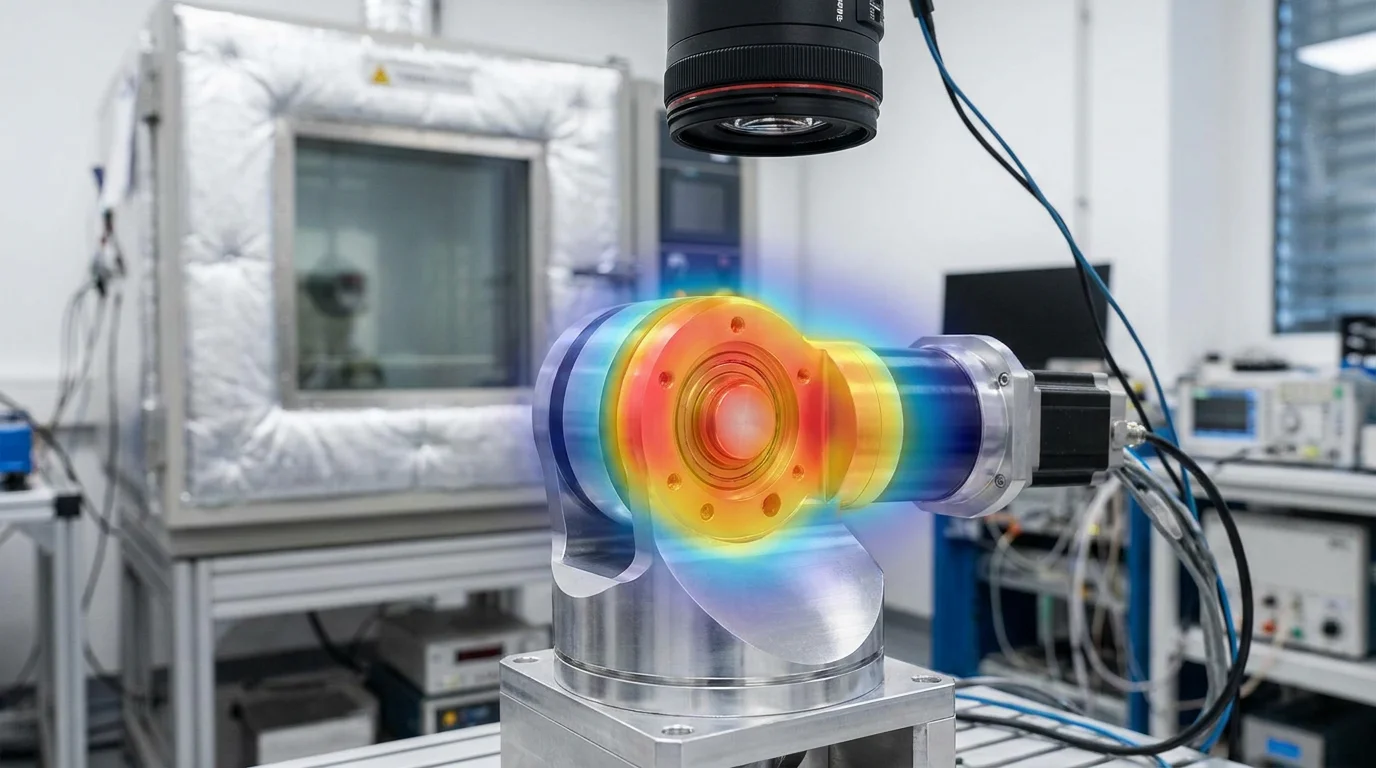
Continuous operation at peak torque will overheat any actuator. Ask the supplier if they have a tool or a detailed guide that helps you calculate the expected temperature rise based on your motion profile. This is much better than trial-and-error during the prototyping phase.
3. What functional safety certifications do you currently hold?
Don't just take their word for it. Ask for the certificate numbers for ISO 13849 or IEC 61508. If the module is 'designed to meet' a standard but isn't yet certified, you need to know that, as it will increase the burden on your own safety certification process.
Technical illustration for What to Ask Your Robot Joint Module Supplier Before Placing an Order.
4. How do you handle firmware updates and version control?
As you move into mass production, you need consistency. Ask the supplier how they notify customers of firmware changes and if they can lock a specific version for your orders. Also, verify how firmware is updated in the field—is it over the EtherCAT/CAN bus, or does it require a special cable?
5. What is your support capacity for custom modifications?
Sometimes a standard off-the-shelf module isn't quite right. Do they offer custom shaft designs, different connector orientations, or specialized coatings? Knowing their willingness and minimum order quantities (MOQ) for customizations can be a deciding factor for unique OEM designs.
6. What per-serial test data and documentation ships with every unit?
Headline datasheet numbers describe the whole product line; the unit on your bench is described by its own serial record. Ask whether every module ships with a per-serial test report — measured no-load current, backlash in arcminutes, torque ripple and encoder calibration at the nominal 48 V DC bus — and which pass/fail gates the supplier enforces before shipping. At a minimum, request these documents before you commit:
| Document | What it should contain |
|---|---|
| Per-serial test report | Measured continuous and peak torque, no-load current, backlash, encoder offset, test operator and date |
| Torque-speed curve | Curves at 48 V DC plus at least one derated bus voltage, with thermal derating vs ambient temperature |
| CAD model | STEP/IGES with true mass and center of gravity — not a simplified shell |
| Integration files | EtherCAT ESI/XML, CANopen EDS, wiring diagram and connector pinout |
Also confirm the firmware version is readable on every unit and that batch records tie serial numbers to build dates and component lots — essential when your own product must satisfy ISO 13485 or AS9100-style traceability.
7. What are the commercial terms: MOQ, lead time and warranty?
Prototype pricing tells you little about production. Pin down the MOQ (PlaPivot runs no MOQ on standard models), the sample lead time versus the production lead time, and what happens when a line is down: the 12-month warranty is a baseline, but ask what it covers — gears, electronics and seals are often treated differently — and whether the supplier ships an advance replacement before the failed unit is returned.
| Term | What a good supplier answers |
|---|---|
| MOQ | No MOQ on standard models; volume pricing after defined annual quantities |
| Sample lead time | Stated in days, with a written delivery date |
| Warranty | 12 months from delivery, covering gear, motor and driver |
| Technical response | Engineering replies within 24 hours |
| RMA process | Advance replacement option and a defined repair turnaround |
8. What is the end-of-life and second-source policy?
Joint modules get discontinued, and a mid-production swap is expensive. Ask for a multi-year availability commitment — a 3–5 year supply horizon is standard for industrial components — advance notice before end-of-life so you can place a final stocking order, and confirmation that a form-fit-function replacement would keep your firmware and wiring unchanged. If you commission a custom shaft, connector orientation or coating, confirm in writing that the customization IP stays with you and that tooling is held for the agreed period.
Ready to start your build?
Our engineering team is ready to help you select the perfect robot joint modules for your application. Get expert advice and a custom quotation within 24 hours.
Get a Quote & DatasheetRelated articles you might find useful:
Need Help Choosing a Joint Module?
Send us your application - load, speed and environment - and our engineering team will respond within 24 hours.
Request Quote & Datasheet Prefer WhatsApp?
Scan or tap the QR to chat