We are standing at the threshold of a new era in robotic actuation. The 'dumb' motor-and-gearbox combinations of the past are giving way to intelligent, self-aware modules that can predict their own failure, adapt to their environment, and communicate in ways we are only beginning to explore. Here is what the future holds for the joints of our robots.
AI-Driven Control and Edge Computing
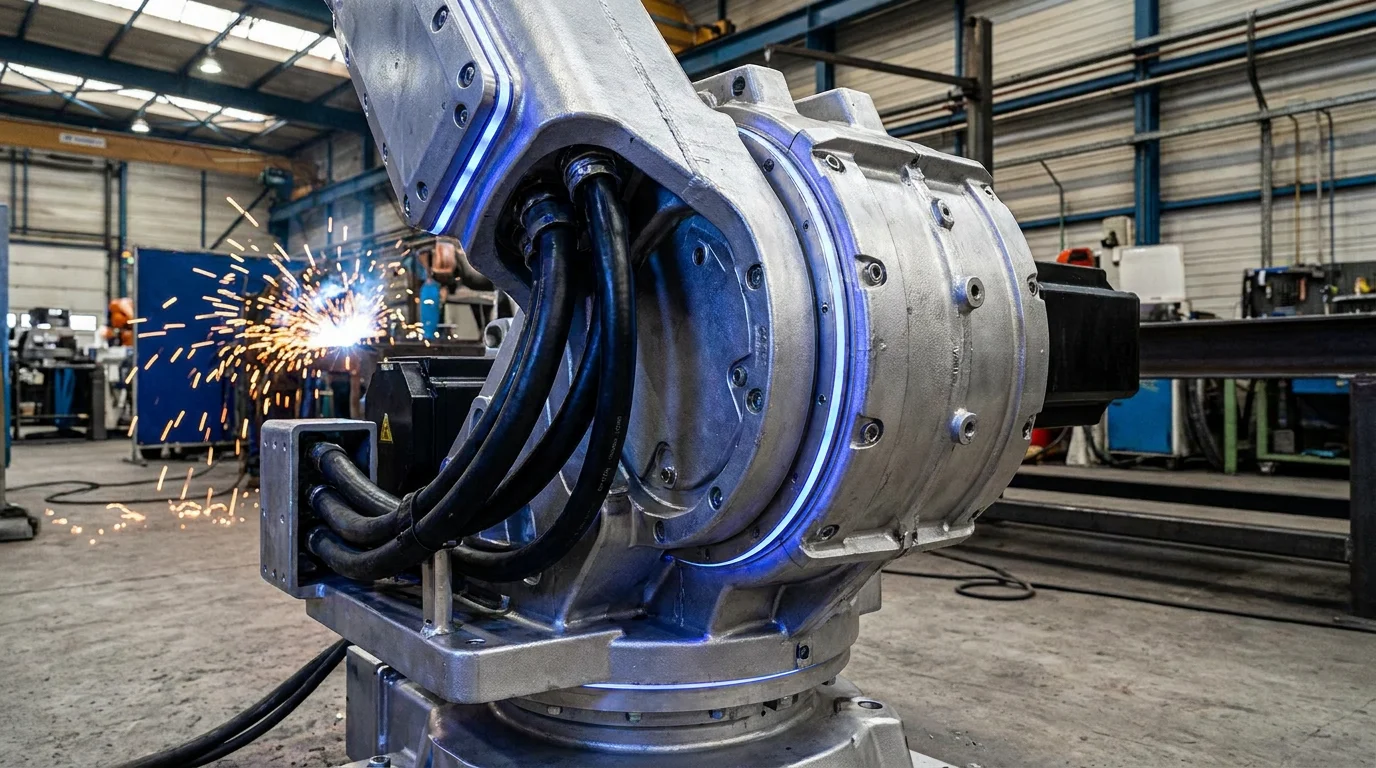
The next generation of joint modules will have enough onboard processing power to run AI models locally. Instead of a central controller calculating every movement, the joints will handle their own vibration suppression, friction compensation, and even path optimization. This 'distributed intelligence' will make robots faster, smoother, and much more responsive to unexpected external forces.
Technical illustration for The Future of Robot Joint Modules: AI-Driven Control, Digital Twins and Smart Actuators.
Digital Twins and Predictive Maintenance
Imagine a joint module that knows it's going to fail two weeks before it actually does. By maintaining a real-time 'digital twin' in the cloud, manufacturers can monitor every cycle, every temperature spike, and every micron of gear wear. Predictive maintenance algorithms will allow companies to replace a joint during a scheduled break rather than suffering an unplanned line stoppage.
The Rise of Smart Materials and Soft Robotics
While metal gears will dominate for years, we are seeing the emergence of smart materials. Shape Memory Alloys (SMAs) and electro-active polymers are paving the way for 'soft' actuators that mimic human muscles. Future joint modules might combine traditional high-torque gears with soft outer layers and tactile sensing, creating robots that are inherently safe and incredibly dexterous.
Technical illustration for The Future of Robot Joint Modules: AI-Driven Control, Digital Twins and Smart Actuators.
Wireless Power and Data Transfer
One of the biggest failure points in robotics is the internal cabling that gets twisted and worn during rotation. The future of joint modules lies in wireless power transfer and ultra-low-latency 6G or proprietary wireless data links. A 'cable-free' joint would have unlimited rotation capability and drastically reduced maintenance needs, opening up new possibilities for complex robotic kinematics.
Sustainability and the Circular Economy
As millions of robots enter the workforce, the environmental impact of their production and disposal becomes a concern. Future joint modules will be designed for the circular economy—modular enough to be easily remanufactured, using rare-earth-free magnets, and constructed from fully recyclable alloys. Sustainability will become as important a metric as torque density or precision.
The Intelligence Ladder: From Servo Loops to Self-Learning Joints
"AI-driven" is not a new kind of motor — it is an incremental upgrade of the control stack that already runs inside an integrated joint. Today's modules close a current loop at 8–16 kHz, a velocity loop at roughly 1 kHz, and a position loop synchronized to the fieldbus cycle (≤1 ms on EtherCAT). The step toward onboard intelligence reuses that infrastructure: model-based friction compensation, adaptive inertia estimation and load-identification routines run on the same DSP that already handles commutation, and their outputs tune the existing loops instead of replacing them.
What makes this practical is instrumentation. A module with an integrated driver and 17-bit dual absolute encoders (motor + output) already samples torque, current, temperature and position error locally at kilohertz rates — the exact dataset predictive-maintenance models need — without loading the central controller. Onboard inference then adds fault classification and micro-adjustments, while the safety-critical path stays in deterministic, certified logic.
What "Future-Ready" Means for a 48 V Module Today
The roadmap above only lands if the electrical architecture can carry it. Four capabilities separate a joint you can upgrade in firmware from one you will have to replace in hardware:
| Capability | Why it matters for the next decade |
|---|---|
| 48 V DC bus | The de facto standard for collaborative and mobile robots — one battery or PSU feeds the whole arm, and touch voltage stays low in shared spaces. |
| EtherCAT / CAN FD | Distributed clocks give multi-axis synchronization today; the bandwidth headroom carries streaming diagnostics and firmware updates tomorrow. |
| 17-bit dual absolute encoders | True output position without homing — and the high-rate feedback that AI maintenance models are trained on. |
| Integrated driver | Distributed intelligence is impossible if every joint still needs an external drive cabinet and a bundle of motor cables. |
The PP-series already ships with all four, which is why moving to smarter control software is a firmware update, not a hardware swap.
Future-Proofing Your Joint Module Purchase: A Checklist
- ☐ Protocol: EtherCAT or CAN FD with a documented firmware update and rollback path — never a proprietary bus.
- ☐ Feedback: dual absolute encoders (motor + output) so diagnostics and AI models see the true output position.
- ☐ Power: 48 V DC compatible with the arm's existing electrical system.
- ☐ Thermal headroom: continuous rating covers your real duty cycle at the stated ambient temperature (S1).
- ☐ Vendor support: published datasheets, per-serial test data and a response within 24 hours when integration questions arise.
The future is not a different kind of actuator — it is a smarter, better-instrumented version of today's joint. Choosing the right electrical and sensing architecture now is what makes AI-driven control, digital twins and predictive maintenance possible later.
Ready to start your build?
Our engineering team is ready to help you select the perfect robot joint modules for your application. Get expert advice and a custom quotation within 24 hours.
Get a Quote & DatasheetRelated articles you might find useful:
Need Help Choosing a Joint Module?
Send us your application - load, speed and environment - and our engineering team will respond within 24 hours.
Request Quote & Datasheet Prefer WhatsApp?
Scan or tap the QR to chat