The world of 3D printing is growing—literally. Large-Format Additive Manufacturing (LFAM) is pushing the boundaries of what's possible in aerospace, automotive, and construction. As we move away from restrictive gantry systems toward flexible 6-axis robotic arms, the role of integrated robot joint modules has become the cornerstone of high-precision, large-scale production.
Beyond the Gantry: Why 6-Axis Printing Wins
Traditional 3D printers rely on Cartesian gantries (X, Y, Z). While stable, they are limited by their build volume and can only print layer-by-layer in a flat plane. By using robotic arms powered by precision joint modules, manufacturers can achieve non-planar printing. This allows for smoother surface finishes on curved parts and the ability to print reinforcing structures along stress lines, significantly increasing part strength while reducing material waste.
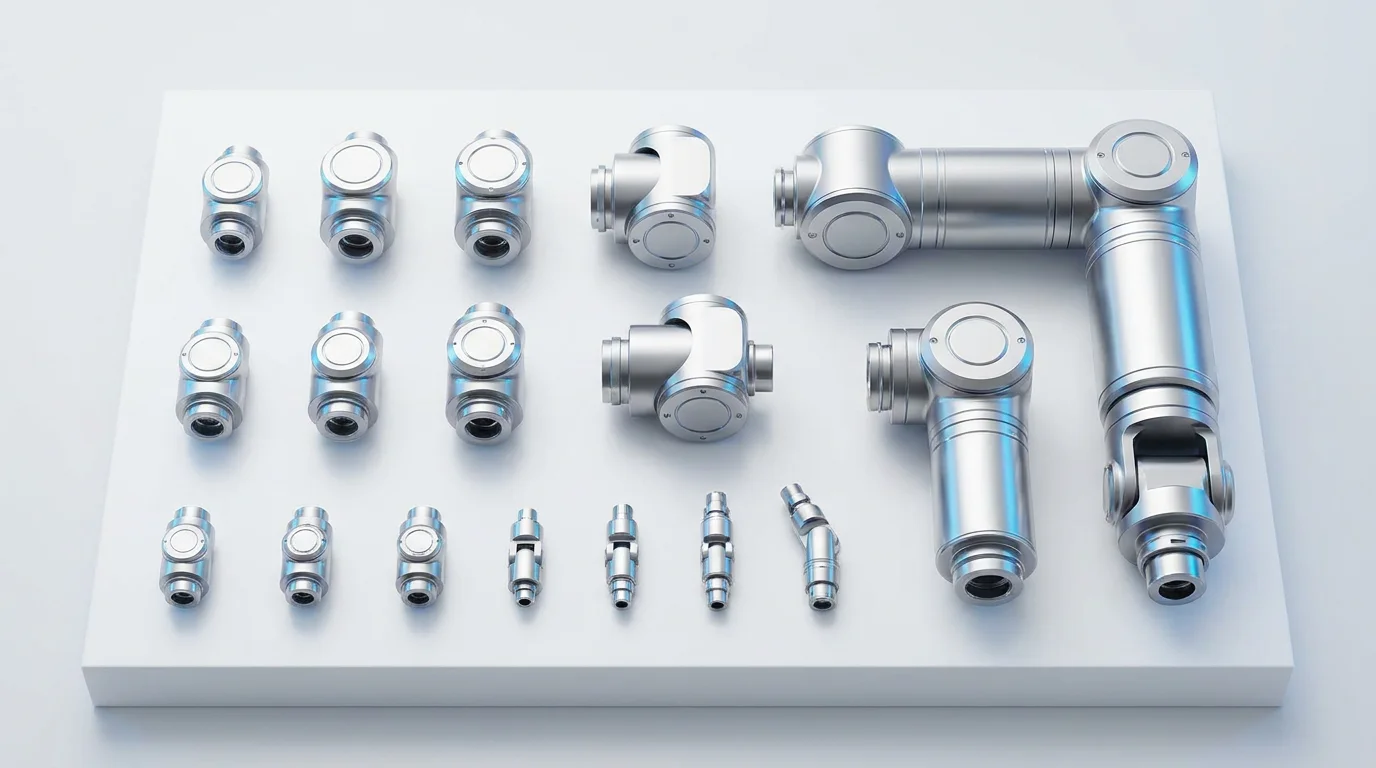
Technical illustration for Using Robot Joint Modules in Large-Format 3D Printing and Additive Manufacturing.
Managing Heavy Payloads with Precision
Large-format printing often involves heavy extruders. Pellet extruders, which are more economical for large parts than filament, can weigh 10kg to 50kg. Standard industrial robots might struggle with the continuous, fine-grained path-following required for 3D printing when carrying such a load. Modern integrated joint modules provide the high torque-to-weight ratio needed to maintain sub-millimeter precision even when the arm is fully extended with a heavy print head.
The Importance of Zero-Backlash in Layer Consistency
In 3D printing, a deviation of just 0.1mm can result in a visible defect or a structural weakness. Harmonic drive gearboxes within the joint modules are essential because they offer near-zero backlash. When the robot changes direction at the end of a perimeter, any 'play' in the joints would cause the extruder to lag, leading to blobs or gaps. Precision actuators ensure the nozzle is exactly where the slicer software expects it to be, every single millisecond.
Technical illustration for Using Robot Joint Modules in Large-Format 3D Printing and Additive Manufacturing.
Thermal Stability in Heated Environments
Many large-scale materials, like carbon-fiber-reinforced polymers, require heated build environments or at least high-temperature extrusion. This heat radiates back into the robot arm. Joint modules for 3D printing must be designed with high-temperature-rated encoders and lubricants that won't degrade. Furthermore, the integrated electronics must have efficient cooling or thermal compensation algorithms to prevent drift as the machine heats up over a multi-day print.
Software Integration: G-Code to Robot Kinematics
One of the biggest hurdles in robotic 3D printing is the translation of G-code into robot joint movements. Using smart actuators with high-resolution feedback (17-bit or 18-bit absolute encoders) simplifies this process. These modules provide the precise position data required for advanced kinematic solvers to maintain constant linear velocity at the nozzle—a critical factor for uniform bead width and layer adhesion.
Ready to start your build?
Our engineering team is ready to help you select the perfect robot joint modules for your application. Get expert advice and a custom quotation within 24 hours.
Get a Quote & DatasheetRelated articles you might find useful: