In the world of precision robotics, 'backlash' is the enemy of accuracy. It is the slight 'play' or clearance between mating gear teeth that causes a lag in motion when direction is reversed. To achieve the sub-micron precision required for semiconductor assembly or surgical robots, engineers must employ advanced design strategies to eliminate this play.
The Physics of Backlash
Every traditional gear system needs some clearance to allow for lubrication and thermal expansion. Without it, the gears would jam or wear out prematurely. However, in a multi-axis robot arm, the backlash of each joint is cumulative. A few arc-minutes of play at the base can result in several millimeters of error at the end-effector. Designing for low backlash requires a fundamental shift in how we think about gear engagement.
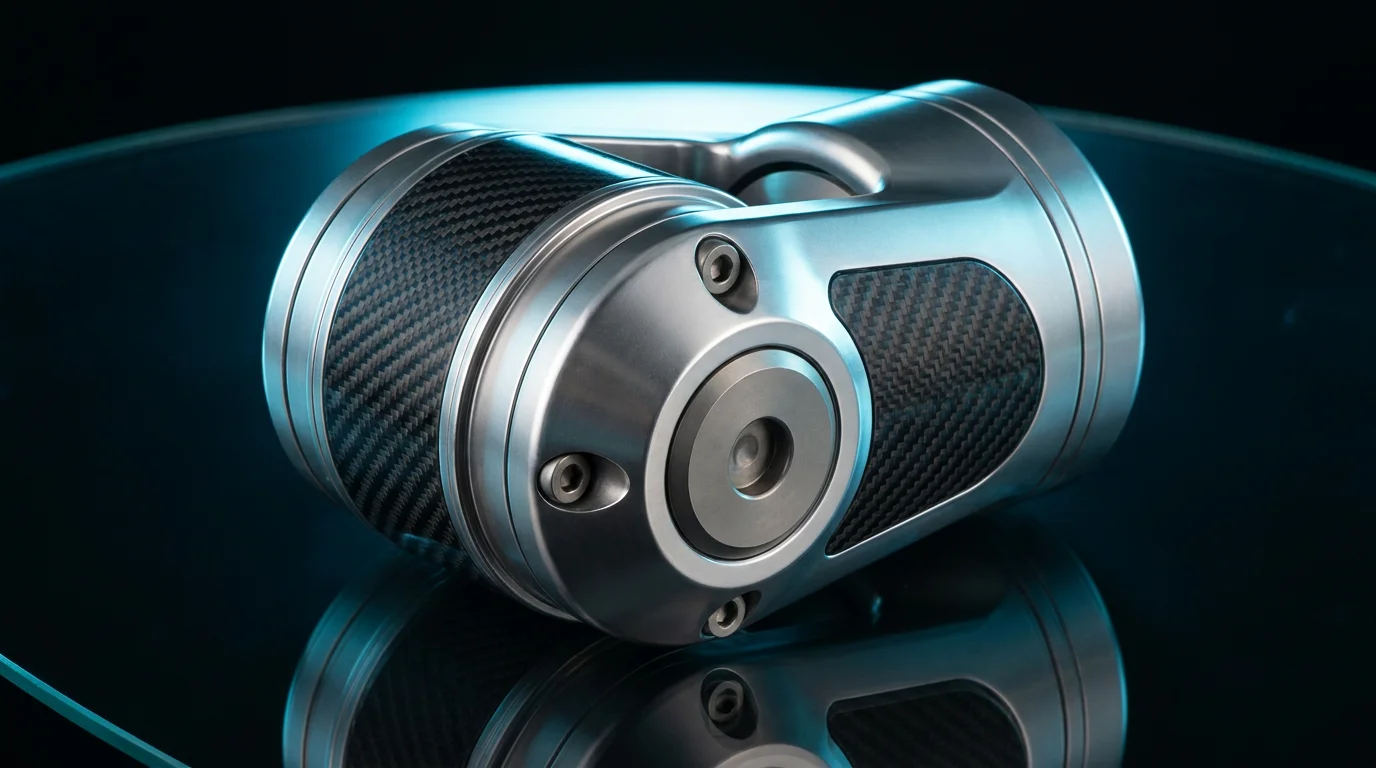
Technical illustration for Designing for Zero Backlash: The Engineering Behind Precision Robot Joints.
Harmonic Drive: The Zero-Backlash Gold Standard
The most common solution for zero-backlash in robotics is the strain wave gear, often called a Harmonic Drive. It uses a flexible spline that is deformed by an elliptical wave generator to engage with a circular spline. Because several teeth are always in contact and the engagement is preloaded, there is virtually zero play. This technology allows for massive reduction ratios (up to 160:1) in a very compact, lightweight package.
Cycloidal Drives for High Shock Resistance
While harmonic drives are precise, they can be delicate. For applications involving high shock loads, such as heavy-duty industrial arms or palletizers, cycloidal drives are preferred. These use eccentric rolling elements instead of traditional gear teeth. By using dual-disk configurations, cycloidal drives can achieve very low backlash (less than 1 arc-min) while being significantly more robust than their strain-wave counterparts.
Technical illustration for Designing for Zero Backlash: The Engineering Behind Precision Robot Joints.
Electronic Backlash Compensation
When mechanical zero-backlash isn't feasible or cost-effective, we turn to electronics. By using dual encoders—one on the input (motor) and one on the output (load)—the controller can 'see' the backlash. Advanced algorithms can then compensate for this play in real-time. While this doesn't fix the mechanical play, it ensures the controller knows exactly where the load is, greatly improving the system's repeatability.
Manufacturing Tolerances and Material Selection
Achieving low backlash isn't just about the design; it's about the manufacturing. We use ultra-precision CNC grinding and gear-shaping machines with tolerances measured in microns. Furthermore, the selection of materials—such as high-strength chrome-moly steel for gears and ceramic balls for bearings—ensures that the precision lasts. Thermal expansion must also be managed through careful material matching to ensure the backlash doesn't change as the joint heats up.
Measuring and Specifying Backlash: From Arcminutes to Microns
Backlash is rated at the output shaft, in arcminutes (1 arcmin = 1/60 of a degree). The unit matters because the error grows with radius: at a 100 mm tool flange, a single arcmin of joint play becomes roughly 0.029 mm (29 µm) of position error at the tool. That is why a sub-arc-minute rating is non-negotiable for welding torch paths, semiconductor die bonding or surgical instruments.
The standard measurement locks the input, applies a small alternating torque (typically 3% of rated), and reads the output displacement with a rotary encoder or laser interferometer. The result separates backlash (clearance) from compliance (elastic deflection under load) — two effects buyers routinely mix up.
| Precision spec | PP-series harmonic values |
|---|---|
| Backlash | <1 arcmin (smaller modules); <0.5 arcmin (largest modules) |
| Repeatability | ±0.003° (smaller modules); ±0.002° (largest modules) |
| Encoder resolution | 17-bit dual absolute (motor + output) |
The Engineering Trade-Offs of Going to Zero
Zero backlash is never free. Preloading gear teeth removes clearance but adds friction torque, which lowers efficiency by a few points and raises operating temperature. In a strain wave gear this friction comes from the flexspline's preloaded tooth engagement; in a cycloidal it comes from preloaded rollers. The practical consequences:
- Efficiency: expect a few percent loss versus a conventionally meshed gear of the same ratio.
- Heat: continuous torque must be derated in hot environments; the S1 rating assumes a stated ambient.
- Lifetime: lubrication and flexspline wear become the life-limiting factors, so maintenance intervals matter more.
Match the precision grade to the application: sub-arc-minute for welding, semiconductor and optical alignment; 3–5 arcmin is often acceptable for AGV drive wheels and positioning tables where reversal accuracy is not critical.
Verifying Low Backlash on the Bench: A Checklist
- ☐ Lock the input shaft; measure output play with a dial indicator at a known radius.
- ☐ Repeat at 3% and 50% of rated torque to separate clearance from compliance.
- ☐ Cycle the joint 100 times and re-measure — preload seating changes the first hours of readings.
- ☐ Measure at operating temperature; thermal expansion of housing and gear alters clearances.
- ☐ Confirm the encoder is ≥17-bit so electrical resolution never masks mechanical play.
Ready to start your build?
Our engineering team is ready to help you select the perfect robot joint modules for your application. Get expert advice and a custom quotation within 24 hours.
Get a Quote & DatasheetRelated articles you might find useful: