AGVs (Automated Guided Vehicles) and AMRs (Autonomous Mobile Robots) are no longer just 'forklifts without drivers.' Modern mobile robots are increasingly equipped with manipulator arms to perform complex tasks like piece picking, machine tending, and laboratory automation. These mobile manipulators require a new breed of joint modules.
The Challenge of Mobile Manipulation
When you put a robot arm on a mobile base, the engineering challenges multiply. Unlike a stationary industrial robot bolted to a concrete floor, a mobile manipulator must deal with a limited power budget (battery operated) and a dynamic, often uneven, environment. The joint modules in the arm must be exceptionally lightweight to avoid making the robot top-heavy or reducing its battery life. Furthermore, they must be robust enough to handle the constant vibrations and occasional bumps that occur as the AMR navigates through a busy warehouse or factory floor.
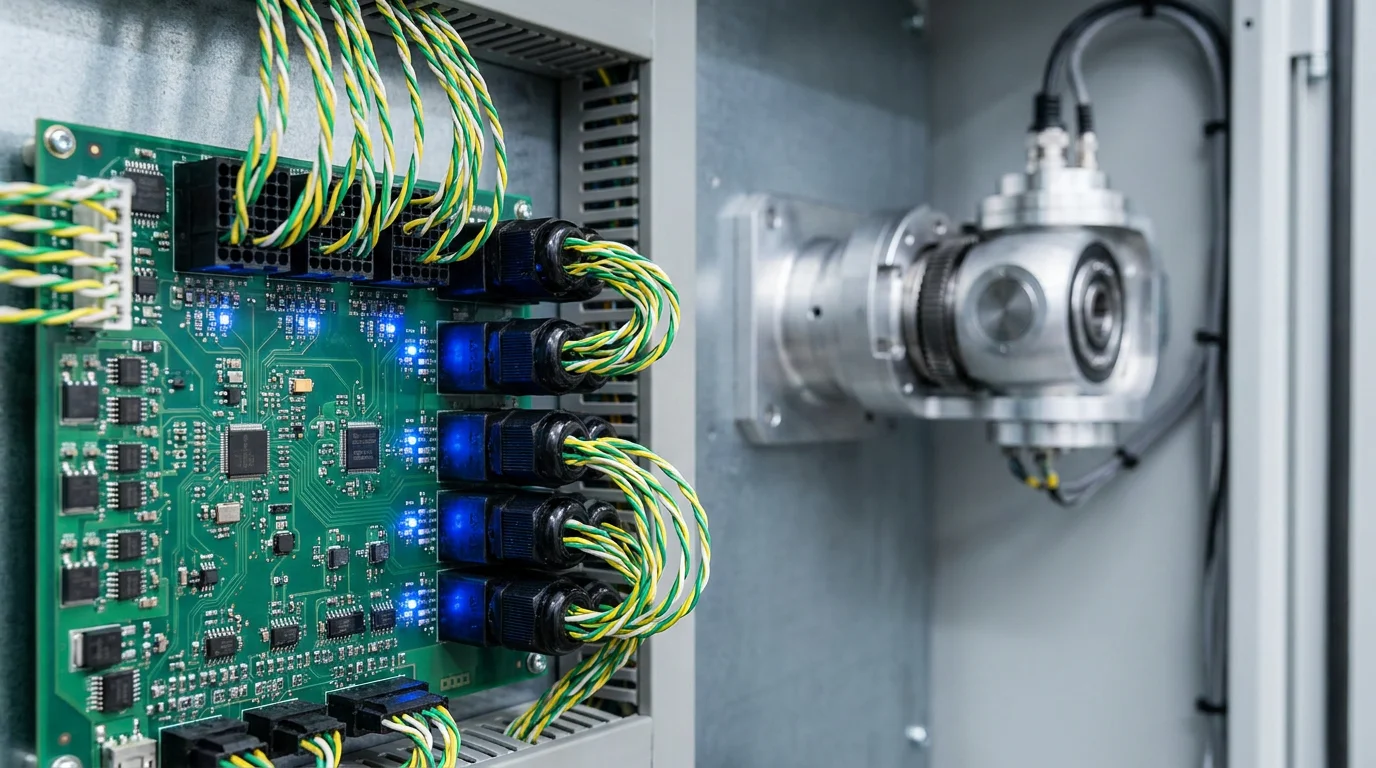
Technical illustration for Robot Joint Modules for AGV and AMR Manipulator Arms.
Optimizing for Battery Life and DC Power
Every milliampere counts when a robot is running on a battery. Joint modules for AGVs and AMRs are typically optimized for 24V or 48V DC operation, matching standard industrial battery systems. Efficiency is the top priority; this means using high-efficiency brushless motors and low-friction gearboxes. Advanced power management features, such as low-power 'sleep' modes for joints that aren't currently moving, are essential. Some modules also support regenerative braking, which can slightly extend the robot's runtime by capturing energy during deceleration and feeding it back into the system.
Weight Reduction and Power Density
For a mobile robot, every kilogram of arm weight is a kilogram of payload it can't carry. This drives the demand for high-power-density joint modules. Engineers use lightweight materials like aluminum-lithium alloys or carbon fiber reinforced plastics for the module housings. The integration of the motor, gearbox, and electronics into a single, compact unit is critical to minimize the overall volume of the arm. By using modules with integrated drivers, the need for a bulky external control cabinet is eliminated, allowing the entire arm and its control system to be mounted cleanly on top of the AMR.
Technical illustration for Robot Joint Modules for AGV and AMR Manipulator Arms.
Dealing with Base Motion and Vibration
A manipulator arm on a moving base is constantly subjected to external forces. As the AMR accelerates, turns, or hits a bump, the joints must compensate for these disturbances to keep the end-effector stable. High-bandwidth control loops and integrated IMUs (Inertial Measurement Units) within the joint modules are becoming common. These sensors allow the joint to detect base motion and apply corrective torques almost instantaneously. Additionally, the mechanical design of the gears and bearings must be able to withstand the 'shock loads' that occur during mobile operation without losing precision or developing backlash.
Safety in Shared Human-Robot Spaces
Since AMRs often operate in the same aisles as human workers, safety is paramount. The joint modules used in mobile manipulators are frequently 'cobot-style' actuators, featuring integrated torque sensors for collision detection. If the arm accidentally bumps into a person or an obstacle, the joints can detect the unexpected resistance and stop immediately. Some advanced modules even include 'dual-channel' safety electronics that meet ISO 13849 standards, ensuring that the safety system remains functional even if one component fails. This high level of integrated safety is what allows mobile robots to work side-by-side with humans in logistics and manufacturing.
Ready to start your build?
Our engineering team is ready to help you select the perfect robot joint modules for your application. Get expert advice and a custom quotation within 24 hours.
Get a Quote & DatasheetRelated articles you might find useful: