Delta robots and parallel link configurations are the speed demons of the robotics world. Their unique kinematics, where multiple arms work together to move a single platform, place specific demands on the joint modules. Choosing the right actuators is critical for achieving the high accelerations these robots are known for.
Understanding Delta Robot Kinematics
Unlike a serial robot arm where each joint carries the weight of all subsequent joints, a delta robot's actuators are typically mounted to a stationary base. They move three (or four) parallel arms that connect to a lightweight end-effector platform. This configuration allows the heavy motors to stay stationary, drastically reducing the moving mass. Because the motors don't have to 'move themselves,' delta robots can achieve accelerations of over 10G and speeds exceeding 200 picks per minute. The joint modules used at the base must therefore be optimized for high-speed, repetitive motion and rapid direction changes.
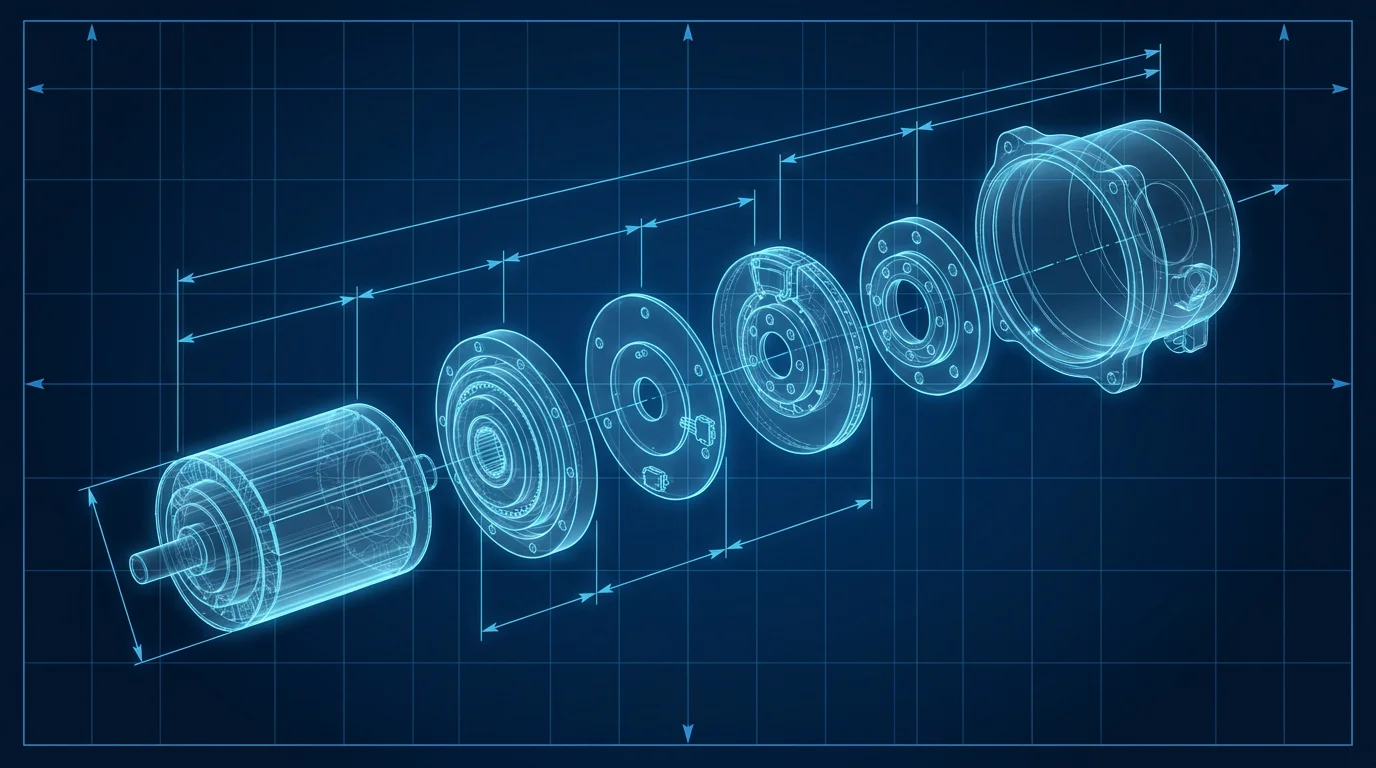
Technical illustration for Selecting Joint Modules for Delta and Parallel Robot Configurations.
Prioritizing Low Inertia and High Torque
In a delta robot, the 'reflected inertia' of the joint module is a key performance bottleneck. To achieve lightning-fast starts and stops, the motor's rotor and the gearbox must have the lowest possible inertia. High-torque-density motors are essential; they provide the 'punch' needed to accelerate the arms without adding excessive weight. Gearboxes with relatively low reduction ratios (often 30:1 to 50:1) are common in delta robots to allow for high output speeds, whereas a serial arm might use 100:1 or higher for maximum payload. The goal is to find the 'sweet spot' where the actuator can provide enough torque to move the load while maintaining the ability to spin at high RPM.
The Critical Role of Synchronization
In a parallel robot, all three base joints must work in perfect harmony. If one joint lags by even a few milliseconds, the end-effector will deviate from its path, potentially causing a collision or a missed pick. This makes the communication protocol and the controller's synchronization capabilities paramount. EtherCAT is the standard choice here, as its Distributed Clock (DC) feature ensures that all modules receive their motion commands at the exact same nanosecond. High-resolution feedback is also vital; the controller needs to know the precise position of each arm to maintain the geometric integrity of the delta structure during high-speed maneuvers.
Technical illustration for Selecting Joint Modules for Delta and Parallel Robot Configurations.
Thermal Management for High-Duty Cycles
Delta robots are often used in 24/7 pick-and-place applications with almost 100% duty cycles. This continuous, high-speed operation generates significant heat within the joint modules. Since the motors are mounted to a stationary base, it is easier to implement external cooling solutions like heat sinks or even active fan cooling. However, the internal design of the module must also facilitate heat transfer from the motor windings and the gearbox to the housing. High-temperature-rated insulation and specialized greases that don't thin out when hot are essential to ensure the robot doesn't lose accuracy or fail during a long production shift.
Selecting Joints for the 'Fourth Axis'
Most delta robots include a fourth axis—a rotating shaft that runs down the center to provide orientation for the end-effector. This axis often uses a smaller, lightweight joint module mounted directly on the moving platform or a telescoping drive shaft connected to a base-mounted motor. If the joint is mounted on the platform, weight is the absolute priority, as every gram added to the distal end reduces the robot's overall acceleration. Small, integrated actuators with high power-to-weight ratios are ideal for this application, often using specialized lightweight housings made of magnesium or high-strength plastics to minimize the moving mass.
Ready to start your build?
Our engineering team is ready to help you select the perfect robot joint modules for your application. Get expert advice and a custom quotation within 24 hours.
Get a Quote & DatasheetRelated articles you might find useful: