Laboratory automation is moving beyond simple X-Y gantry systems. Today's labs require flexible robotic arms capable of pipetting, moving microplates, and tending to complex analytical instruments. These applications demand a unique type of joint module: one that is ultra-precise, whisper-quiet, and small enough to fit inside a standard biosafety cabinet.
1. Precision Pipetting: The Need for Sub-Millimeter Accuracy
In liquid handling, the difference between success and failure is often measured in microliters. A robot arm must be able to position a pipette tip exactly in the center of a 384-well plate. This requires joints with zero backlash and extremely high encoder resolution. Our PP-65 and PP-80 modules are perfect for lab arms because their 23-bit absolute encoders provide the 'granularity' (over 8 million positions per turn) needed for these delicate tasks. Because they are integrated modules, they offer the mechanical 'stiffness' required to move quickly between wells without the 'slosh' or vibration that could contaminate samples. High-precision movement allows for higher throughput and better experimental repeatability.
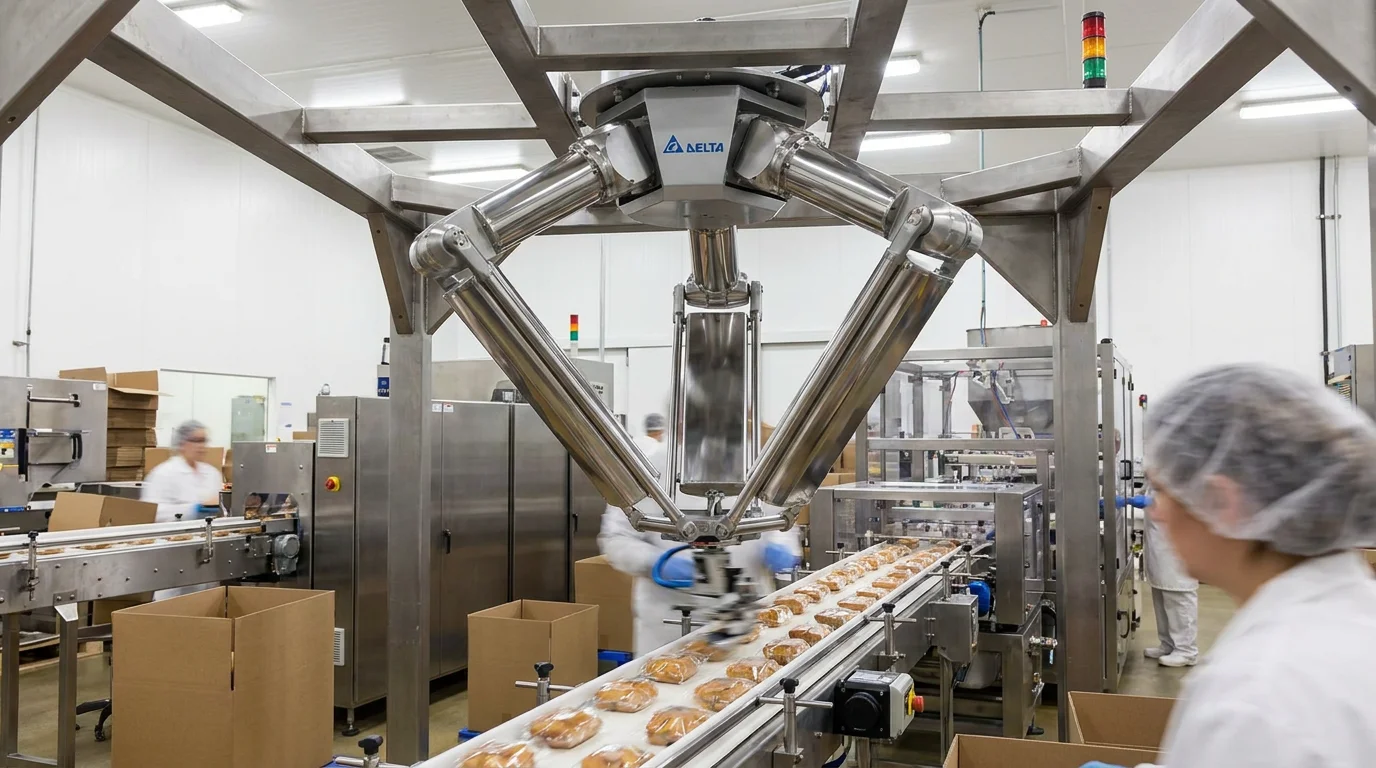
Figure: Technical implementation of Robot Joint Modules in Laboratory Automation and Liquid Handling. High-precision components for reliable robotic motion.
2. Cleanliness and 'Zero-Contamination' Design
Labs are sterile environments. A robot joint shouldn't shed particles or leak lubricants. Traditional gearboxes can be 'messy,' but our integrated modules are completely sealed with high-grade gaskets. The harmonic drive is lubricated with high-grade, low-outgassing grease that is designed to stay exactly where it belongs, even at high speeds. Furthermore, the smooth aluminum housing is easy to wipe down with isopropyl alcohol, hydrogen peroxide, or other common lab disinfectants. The hollow-shaft design is a major benefit here, as it allows all the complex tubing for liquid handling or vacuum lines to be routed *inside* the arm, preventing them from dragging across sterile surfaces or accidentally knocking over vials or tubes.
3. Silent Operation for Shared Workspaces
Unlike a noisy car factory, a lab is a place of focus. A robot that 'whines' or 'grinds' all day is a significant distraction for lab technicians and researchers. Because PlaPivot modules use PMSM motors and pure sinusoidal commutation, they are almost completely silent, even at full speed. The only sound you'll hear is the faint, high-frequency 'hum' of the harmonic drive. This makes them ideal for 'cobot' lab assistants that work directly alongside scientists in shared workspaces. Low acoustic noise is also a signal of high mechanical efficiency and low internal vibration, which further contributes to the overall precision of the laboratory system.
Figure: Technical implementation of Robot Joint Modules in Laboratory Automation and Liquid Handling. High-precision components for reliable robotic motion.
4. Compactness for 'Tabletop' Automation
Space on a lab bench or inside a biosafety cabinet is incredibly expensive. Lab automation robots need to have a very small footprint. By using our compact PP-series modules, you can build a 6-axis arm that has the reach of a human arm but fits on a base no larger than a coffee mug. This allows for 'multi-robot' setups where several small arms can work together in a single workspace without interfering with each other. Whether you are building an automated COVID-testing station or a custom drug-discovery platform, the power density and precision of integrated joint modules provide the essential foundation for modern 'Life Science' robotics. Their compact size also makes them portable for flexible lab setups.
5. Integration with Lab Software and LIMS
Modern labs are driven by data. Our joint modules are designed to integrate seamlessly with Laboratory Information Management Systems (LIMS) and automation software like ROS or custom Python-based controllers. Because they use standard communication protocols (CANopen/EtherCAT), it's easy to write scripts that coordinate the robot's movement with the timing of a centrifuge, an incubator, or a mass spectrometer. This 'software-defined' robotics approach allows labs to reconfigure their automation workflows in hours rather than weeks. PlaPivot provides extensive documentation and API support to ensure that your lab robot is up and running—and talking to your instruments—with minimal development effort. This digital integration is the key to the 'Lab of the Future.'
Ready to start your build?
Our engineering team is ready to help you select the perfect robot joint modules for your application. Get expert advice and a custom quotation within 24 hours.
Get a Quote & DatasheetRelated articles you might find useful: