In the world of precision robotics, the term 'backlash' is often whispered with dread. It is the hidden enemy of accuracy, the source of jittery motion, and the primary reason why cheap gearboxes fail in professional applications. This deep dive explores the physics of backlash and why zero-backlash technologies like harmonic drives are non-negotiable for modern robot builds.
1. What Exactly is Backlash? The Engineering Definition
Backlash is the clearance or 'play' between mating gear teeth. In a traditional planetary or spur gearbox, a small gap must exist between the teeth to prevent jamming and allow for lubrication and thermal expansion. When the motor turns in one direction, the teeth engage and move the output. However, when the motor reverses direction, there is a tiny moment where it spins but the output doesn't move as the teeth travel across that gap to hit the opposite side. This lost motion is backlash, usually measured in arc-minutes or arc-seconds. For a standard industrial gearbox, backlash might be 10-30 arc-minutes. While this sounds small, it translates to significant error at the end of a long robot arm. In a precision assembly environment, this means the robot cannot reliably return to the same coordinate after a direction change, leading to failed parts and system drift.
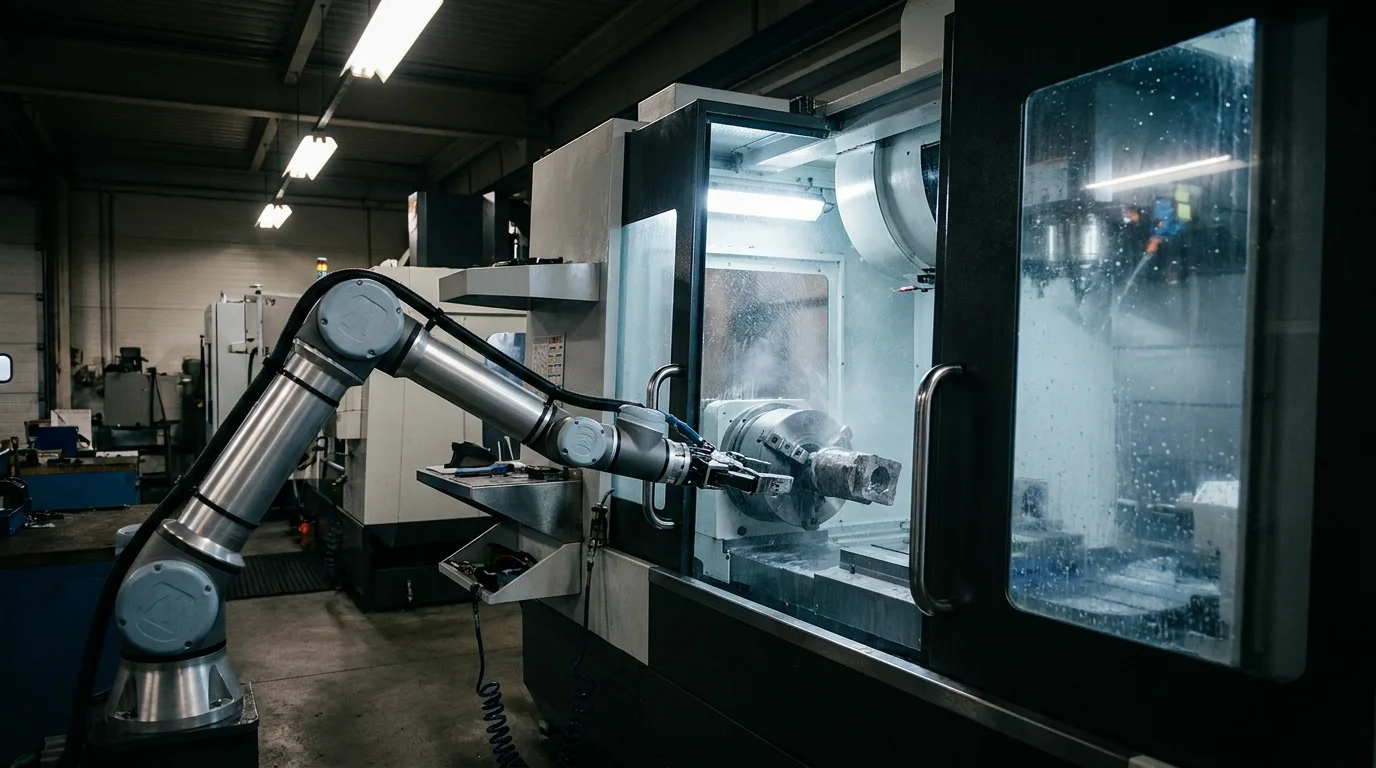
Figure: Technical implementation of What Is Backlash and Why Zero-Backlash Matters in Robot Joints. High-precision components for reliable robotic motion.
2. The Cumulative Error: Why 1 Arc-Minute Matters
Think of a robot arm as a series of levers. If the base joint (J1) has 10 arc-minutes of backlash and the arm is 1 meter long, that tiny angle results in nearly 3 millimeters of 'slop' at the gripper. Now, add the backlash from J2, J3, and J4. By the time you reach the tool tip, your precision robot has become a shaky, unpredictable machine. In applications like electronics assembly, where components are measured in microns, or surgical robotics, where accuracy is a matter of life and death, even a few arc-seconds of backlash are unacceptable. This is why high-end robots don't use standard gears; they use 'zero-backlash' strain wave gears. The cumulative effect of mechanical play across multiple axes is the primary differentiator between a hobbyist arm and a professional industrial manipulator.
3. The Harmonic Drive Solution: Elastic Engagement
How do you eliminate a gap that must exist? You change the physics of the gear. Harmonic drives (or strain wave gears) don't use rigid teeth that mesh together. Instead, they use a flexible 'Flexspline' that is elastically deformed by an elliptical 'Wave Generator.' At any given moment, about 30% of the gear teeth are in full contact and pre-loaded against each other. Because the teeth are always 'pressed' together, there is no gap to cross when reversing direction. This results in 'true' zero-backlash motion. At PlaPivot, our PP-series modules all utilize high-precision harmonic reducers to ensure that every command from the controller results in immediate, exact physical movement. This elastic engagement also provides the benefit of high torque density, as the load is distributed over many teeth simultaneously, reducing the stress on any single gear component.
Figure: Technical implementation of What Is Backlash and Why Zero-Backlash Matters in Robot Joints. High-precision components for reliable robotic motion.
4. Impact on Control Loops and Path Accuracy
Backlash doesn't just affect position; it destroys control stability. When a PID controller tries to move a joint with backlash, it 'hunts' for the target. It overshoots, tries to correct, hits the backlash gap, loses tension, and then 'slams' into the other side of the gear tooth. This causes vibration, audible noise, and increased wear on the gearbox. In contrast, a zero-backlash joint allows for much higher 'gain' settings in the control loop. The robot feels 'stiff' and responsive. This stiffness is what allows a cobot to stay perfectly still when a human pushes against it, or to follow a complex 3D welding path with sub-millimeter consistency. Zero-backlash isn't just about accuracy; it's about the fundamental 'feel' and reliability of the robot. Without the mechanical dead-zone of backlash, the control algorithms can achieve much higher bandwidth, leading to smoother trajectories and faster settling times.
5. Long-Term Reliability and Wear Considerations
In traditional gearboxes, backlash often increases over time as the gear teeth wear down. This means a robot that is accurate today might become useless in six months. Zero-backlash harmonic drives are designed to maintain their precision throughout their rated lifespan. Because the Flexspline is pre-loaded, it automatically 'takes up' the microscopic wear that occurs during operation. At PlaPivot, we subject our joint modules to rigorous endurance testing—millions of cycles under full load—to ensure that the backlash remains within specification for at least 20,000 hours of operation. When selecting a joint for a high-duty-cycle industrial application, the 'maintenance of precision' is just as important as the initial accuracy. A zero-backlash module from our PP-series is an investment in long-term system stability and reduced downtime.
Ready to start your build?
Our engineering team is ready to help you select the perfect robot joint modules for your application. Get expert advice and a custom quotation within 24 hours.
Get a Quote & DatasheetRelated articles you might find useful: