Payload is the most defining characteristic of a robot. Whether you are building a 3kg-class laboratory cobot or a 20kg-class industrial welder, your choice of joint modules will dictate whether your design succeeds or fails. Matching a module to a payload isn't just about 'can it lift it?'—it's about accuracy, thermal stability, and dynamic response.
1. The 3kg to 5kg Range: Precision and Agility
For smaller payloads, the goal is low mass. In a 6-axis arm, the weight of the wrist joints (J4, J5, J6) acts as a load for the shoulder and base. If the wrist modules are too heavy, you 'waste' all your torque just moving the arm itself. For these applications, we recommend our PP-65 and PP-80 series. These modules provide 6Nm to 15Nm of torque while weighing less than 1kg. They are ideal for high-speed pick-and-place, desktop assembly, and medical assistance robots where agility and smooth motion are more important than brute strength.
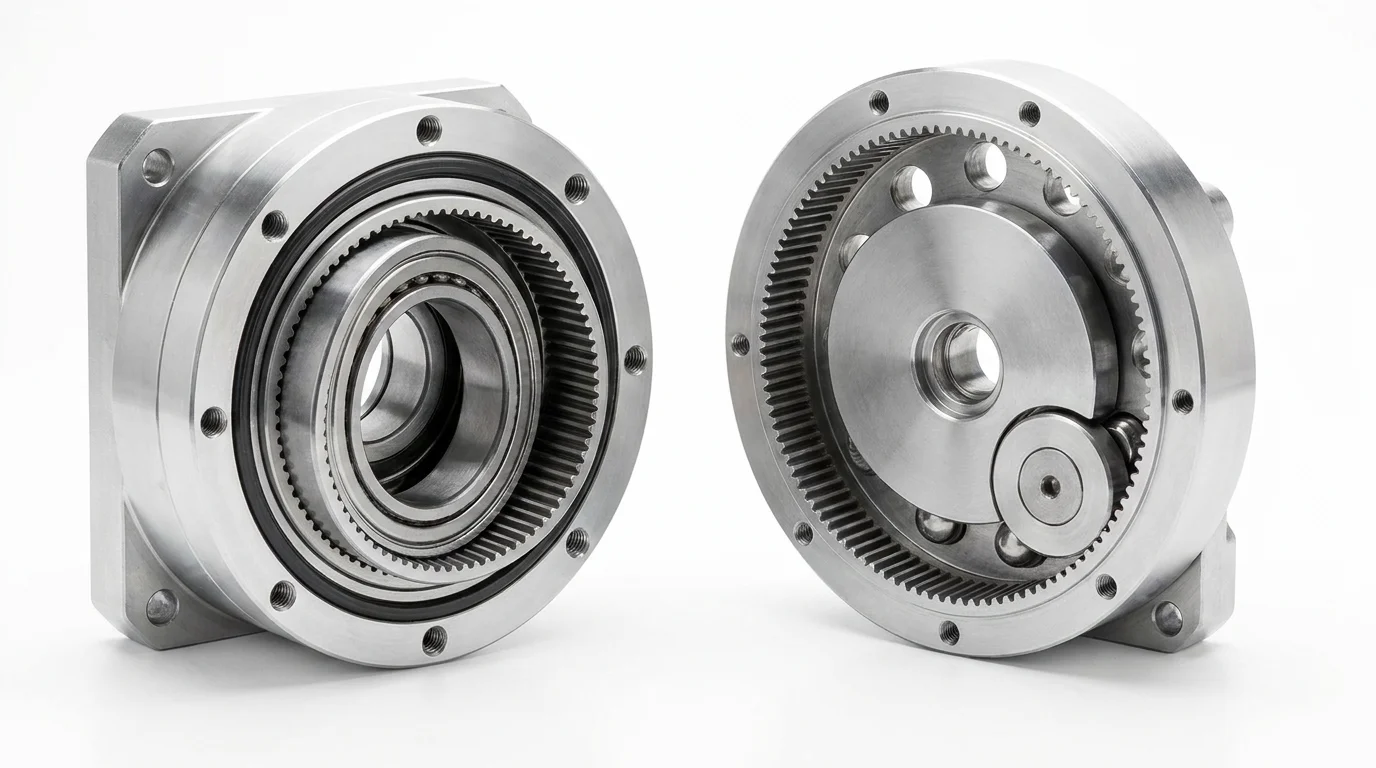
Technical illustration for How to Match Robot Joint Modules to Your Payload Requirements.
2. The 10kg to 15kg Range: The Industrial Sweet Spot
This is the most common payload class for collaborative robots used in machine tending and palletizing. The torque requirements jump significantly, often reaching 50Nm to 120Nm at the base (J1) and shoulder (J2). Our PP-100 and PP-120 series are designed for this 'heavy-lift' duty cycle. They feature larger harmonic drives and higher-wattage motors to handle the continuous stress of moving 10kg at the end of a 1-meter reach. At this scale, thermal management becomes critical; these modules are designed with optimized cooling fins to ensure they can run 24/7 without derating.
3. Reach vs Payload: The Hidden Torque Multiplier
It's a common mistake to size a joint based on payload weight alone. You must consider the 'reach.' A 5kg weight held at 0.5 meters creates 25Nm of torque, but the same weight at 1 meter creates 50Nm. As your robot arm gets longer, the torque requirements at the base joints grow exponentially. When choosing PlaPivot modules, always use our 'Reach-Payload Calculator' to determine the static and dynamic moments. A longer arm also introduces more 'compliance' or flex; using a larger, stiffer joint module can help maintain path accuracy at full extension.
Technical illustration for How to Match Robot Joint Modules to Your Payload Requirements.
4. Selecting for 'Overhung' Loads and Safety
In many applications, the payload isn't just a weight; it's a tool (like a heavy welding torch or a vacuum gripper) that might be offset from the joint axis. This creates 'overhung' or 'moment' loads on the joint's bearings. Our PP-series modules use high-capacity cross-roller bearings that can handle both axial and radial forces simultaneously. This allows the joint to support significant cantilevered loads without mechanical deflection. Finally, ensure your selection has at least 25% torque headroom for emergency stops—when a 10kg payload is moving at 2m/s and needs to stop in 100ms, the 'braking torque' required is far higher than the moving torque.
Ready to start your build?
Our engineering team is ready to help you select the perfect robot joint modules for your application. Get expert advice and a custom quotation within 24 hours.
Get a Quote & DatasheetRelated articles you might find useful: