What This Guide Covers
How to evaluate robot joint module suppliers, negotiate OEM and ODM terms, compare factory-direct pricing from China, verify quality before committing to bulk orders, and structure a supplier agreement that protects your intellectual property and delivery schedule. Written for procurement managers, startup founders, and engineering leads sourcing robotic actuator manufacturer partners.
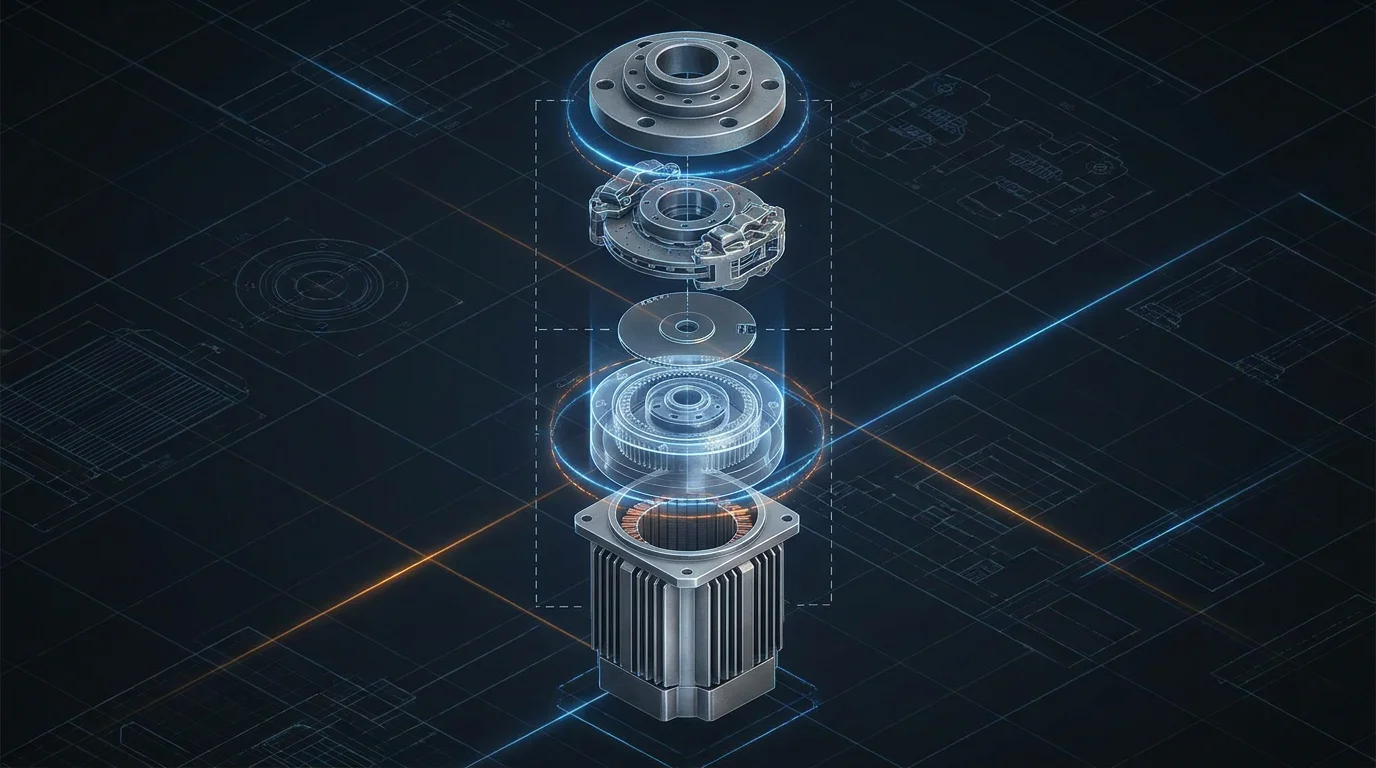
China's actuator manufacturing has matured into a precision-driven industry with ISO-certified facilities.
1. The China Robot Actuator Supply Landscape in 2026
The global supply chain for robot joint modules has shifted dramatically. Five years ago, your choices were essentially Harmonic Drive (Japan), Nabtesco (Japan), or a few premium European integrators — all with 12+ week lead times and high MOQs. Today, a growing cluster of robot actuator factory China operations in the Yangtze River Delta and Pearl River Delta regions can produce harmonic drive modules at 40–60% of the legacy supplier cost, with 1–3 week lead times on standard models.
But not all suppliers are equal. The Chinese robot actuator market ranges from Tier-1 integrated manufacturers with in-house harmonic drive production, ISO 9001 certification, and export experience — to component assemblers who buy reducers on Taobao, machine housings in a garage shop, and disappear when quality issues arise.
This guide gives you the framework to tell the difference.
2. Supplier Tier Classification
| Tier | Characteristics | Price Index | Best For |
|---|---|---|---|
| Tier 1: Integrated Manufacturer | In-house harmonic drive production, CNC machining, motor winding, cleanroom assembly, dyno testing per unit. ISO 9001. Export experience. English-speaking engineering team. | 100 (baseline) | OEM/ODM partnerships, 50+ unit production runs, cobot manufacturers who need supply chain reliability |
| Tier 2: Specialist Integrator | Sources harmonic drives from Tier-1 reducer makers, integrates in-house motors/encoders/drivers. Good QC. Smaller capacity but more flexible on customization. | 75–90 | Small batch orders (10–50 units), moderate customization, startups and R&D teams |
| Tier 3: Component Assembler | Buys all components off-the-shelf, assembles in general-purpose workshops. Inconsistent unit-to-unit quality. Limited testing. Often lowest bidder on Alibaba. | 50–70 | Non-critical applications with wide tolerance windows; price above all else |
PlaPivot sits at Tier 1.5: We produce harmonic drives and motors in-house, machine housings on our own 5-axis CNCs, and dyno-test every module before shipping. We're smaller than the legacy Japanese suppliers — which means lower overhead, faster response, and genuine interest in small-to-medium volume partnerships. No MOQ. No gatekeeping.
OEM partners can customize housing color, connector type, communication protocol, and branding.
3. OEM vs ODM: Which Model Fits Your Business?
Understanding the difference between OEM robot joint module supply and ODM robotic actuator partnerships is critical to structuring the right agreement.
| Aspect | OEM (Original Equipment Manufacturing) | ODM (Original Design Manufacturing) |
|---|---|---|
| What it means | You specify the design; the supplier manufactures to your spec. Your brand on the product. | The supplier designs and manufactures the product; you brand and sell it. May customize existing designs. |
| Who owns the IP | You own the design IP. Supplier has manufacturing know-how. | Supplier owns the core design IP. You own the brand and distribution. |
| Minimum volume | Typically 200+ units to justify tooling | Can start at 50 units if modifying existing platform |
| Lead time (first order) | 12–20 weeks (tooling + prototyping + testing) | 6–12 weeks (modification of existing design) |
| Per-unit cost | Higher at low volume; drops sharply above 500 units | Lower at low volume; supplier absorbs R&D amortization |
| Best for | Established robot brands with proprietary kinematics | Startups, integrators, companies entering robotics from adjacent industries |
For most buyers reading this guide: you probably want an ODM-light model — buy existing custom robot joint module designs with your branding and minor modifications (custom firmware, labeling, connector pinout). This avoids the 12–20 week OEM timeline while giving you a differentiated product. Full OEM joint development only makes sense when your robot's kinematics are genuinely novel and you're projecting 500+ units per year.
Always request calibration certificates and dyno test reports — they separate serious manufacturers from traders.
4. How to Verify a Supplier Before Ordering
The difference between a bulk robot actuator supplier with real manufacturing capability and a middleman with a nice website comes down to verification. Here's what to demand before placing any order above 10 units:
- Factory audit (in-person or video call): Walk through the production floor on a live video call. Look for: CNC machines actively running, harmonic drive component inventory, cleanroom assembly area, dyno test stations with recent test reports visible, and batch traceability labels on components. If they refuse a factory tour — walk away.
- Sample units with full documentation: Order 1–2 units. Demand: dyno test report (torque, speed, efficiency measured on that specific unit), calibration certificate (encoder alignment verified), CAD model (STEP format), wiring diagram, and communication protocol manual. Evaluate the sample on your bench for at least 40 hours of continuous operation before placing a production order.
- Batch consistency data: Ask for test data from a recent production batch of at least 20 units showing torque variation, backlash variation, and encoder error across the batch. The standard deviation tells you more than the mean. A backlash std dev of >0.3 arc-min indicates inconsistent assembly quality.
- Existing customer references: Ask for 2–3 customers in your region or industry who have ordered 50+ units. Contact them. Ask about delivery reliability, defect rate, engineering support responsiveness, and what happened when a unit failed.
- Certification verification: Request copies of ISO 9001, CE, and RoHS certificates. Verify them against the issuing body's online database. A surprising number of "certified" Chinese suppliers have expired or fabricated certificates.
5. Pricing Structure: What to Expect
Understanding the price ladder for robot joint module wholesale purchasing helps you negotiate fairly and spot suppliers who are padding margins:
| Order Quantity | Typical Price per 30Nm Module | What's Included |
|---|---|---|
| 1–5 units | $1,200–$1,500 | Module, test report, CAD model, manual. No volume discount. |
| 6–20 units | $1,000–$1,200 | 5–8% discount. Priority shipping. Standard warranty. |
| 20–50 units | $850–$1,000 | 10–15% discount. Custom firmware option. Extended warranty. |
| 50–200 units | $700–$850 | 20–25% discount. ODM customization. Dedicated engineer. 3-year warranty. |
| 200–500 units | $550–$700 | 30–40% discount. Full OEM available. JIT delivery. Consignment stock options. |
| 500+ units | Negotiable | Custom pricing. Dedicated production line. Co-development partnership. |
Red flag: If a supplier quotes 40% below these ranges for any quantity tier, the cost reduction almost certainly comes from substituting components — lower-grade harmonic drive flexspline material, non-brand encoders, or skip-level binning of motor magnets. Precision robot joints are not a commodity where cost can be halved without quality impact.
6. Intellectual Property Protection When Sourcing from China
This is the #1 concern buyers voice when considering a robot actuator factory China partnership. Here's a realistic framework:
- NDA with China-specific enforcement clause: A standard Western NDA has limited enforceability in Chinese courts. Your NDA must specify: governing law (PRC), dispute resolution venue (CIETAC or HKIAC arbitration), and damages calculation method. Work with a lawyer who has China IP experience — it's a $2,000 investment that can save your business.
- Split the supply chain: If you're doing full OEM (your design), split manufacturing across 2–3 suppliers who each produce different components. Final assembly happens at your facility or a trusted integrator. No single supplier has the complete design.
- Firmware lock: For ODM-level customization, have the supplier flash your proprietary firmware onto the module's driver at the factory. Even if the hardware is copied, the firmware is the control layer that makes it work. Without your firmware, the hardware is a paperweight.
- Trade secret over patent: In robotics, manufacturing process know-how (assembly sequence, calibration procedure, quality inspection checkpoints) is often more valuable than design patents — and harder to reverse-engineer. Protect your process documentation as rigorously as your CAD files.
7. Logistics and Incoterms for International Buyers
When importing industrial robot parts from China, the Incoterm you choose determines who bears shipping risk, insurance, and customs clearance costs:
| Incoterm | Supplier Responsibility | Your Responsibility | Best For |
|---|---|---|---|
| EXW (Ex Works) | Make goods available at factory gate | Everything: pickup, export clearance, freight, insurance, import clearance | Experienced importers with logistics partners in China |
| FOB (Free On Board) | Deliver to port, export clearance | Ocean/air freight, insurance, import clearance | Most common for first-time buyers; balanced risk split |
| CIF (Cost, Insurance, Freight) | Deliver to destination port, including freight and insurance | Import clearance and inland delivery | Convenient but supplier controls carrier and insurance — less transparent |
| DAP (Delivered at Place) | Deliver to your door, excluding import clearance | Import clearance only | Simplest for the buyer; higher supplier cost built into price |
PlaPivot's standard: FOB Shanghai or DAP for orders under 50 units. For bulk orders, we work with your freight forwarder on whatever terms you prefer. Typical air freight to Europe/US: 5–7 days. Sea freight: 25–35 days.
8. Payment Terms and Trade Assurance
The standard payment structure for first-time buyers working with a new robotic actuator manufacturer:
- Sample order (1–5 units): 100% upfront via T/T, PayPal, or Alibaba Trade Assurance. This is normal — no supplier finances a sample order for a new customer.
- Production order (10–50 units): 30–50% deposit, balance before shipment (T/T). Or use Alibaba Trade Assurance for buyer protection — the supplier only gets paid when you confirm receipt.
- Established relationship (50+ units, repeat orders): 30% deposit, 70% net 30 days after shipment. Letter of credit (L/C) for orders above $50,000.
- Red flag: Any supplier demanding 100% upfront for production orders without Trade Assurance. If you have a dispute with an overseas supplier who already has your money, your leverage is near zero.
9. The PlaPivot Difference: What We Actually Deliver
We're not going to tell you PlaPivot is the only good robot joint module supplier — there are excellent manufacturers in China, Japan, and Europe. But here's what differentiates us for the buyer persona reading this guide:
- No MOQ, ever: Order 1 unit or 100. Same engineering support, same documentation package, same quality. We built our business serving robotics startups and R&D teams — not just large OEMs.
- English-speaking engineering team: Not a sales agent reading from a script. Our engineers answer technical questions directly — within 24 hours.
- Dyno test report per unit: Every module that leaves our factory includes its individual test data. Not a generic datasheet. Not a "trust us." Your unit's actual measured torque, speed, backlash, and efficiency.
- Customization without the OEM tax: Firmware modifications, custom connectors, branded labeling — these are standard services, not premium upsells. For 50+ units, most customizations have zero NRE charge.
- Transparent pricing: Our price ladder is published. Volume discounts are explicit. You won't discover that your competitor got a 30% better price because they negotiated harder.
10. Next Steps for Serious Buyers
If you're evaluating robot joint module suppliers for a real project — not just browsing — here's a practical sequence:
- Send us your requirements: Torque per joint, speed, communication protocol, quantity estimate. We'll respond with recommended modules and pricing within 24 hours — no NDA required for preliminary quotes.
- Review the datasheets: We'll send torque-speed curves, CAD files, and wiring diagrams for the recommended models. You evaluate fit with your mechanical and electrical design.
- Order evaluation units: 1–2 modules. Test them on your bench. Run them for 40+ hours. Measure backlash. Stress-test at peak torque. This is the real verification — no website or sales call replaces it.
- Factory tour (virtual or in-person): See our production floor, meet the engineering team, verify our processes. We welcome this — it builds the trust that your production line depends on.
- Production agreement: Once evaluation units pass your testing, we structure a supply agreement with scheduled deliveries, quality KPIs (backlash tolerance, on-time delivery rate), and a warranty framework that protects your production line.
Ready to Evaluate a Robot Joint Module Supplier?
Tell us about your project. We'll respond with a tailored recommendation, pricing, and datasheets within 24 hours. No commitment. No MOQ.
Request Quote & Supplier Evaluation