TL;DR — Quick Selection Checklist
- 1. Determine your payload & reach → calculate required joint torque
- 2. Choose between harmonic drive (precision) and planetary gear (cost)
- 3. Select communication protocol: EtherCAT or CANopen
- 4. Verify IP rating for your operating environment
- 5. Request a datasheet and CAD model from the robot joint module manufacturer
1. Understanding Robot Joint Modules
A robot joint module is the fundamental building block of any multi-axis robotic arm. It's a self-contained mechatronic unit that integrates four critical components into one compact assembly: a frameless torque motor, harmonic drive reducer, dual absolute encoders (input and output side), and an integrated servo driver. This integration eliminates the need to separately source, machine, align, and wire each component — a process that typically consumes 40–60% of a cobot's development timeline.
For cobot designers, the appeal of an integrated joint actuator is clear: reduced mechanical BOM, simplified cabling, factory-calibrated encoder alignment, and predictable torque-speed curves — all backed by a single supplier's warranty and technical support.
2. Step-by-Step Selection Framework
Selecting the right module starts with understanding your payload, speed, and environmental requirements.
Step 1: Calculate Required Torque
Torque is the single most important parameter. For a 6-axis cobot arm, each joint experiences a different load profile:
- J1–J3 (Base & Shoulder): These carry the entire arm's weight plus payload. Typically require 30–150Nm depending on arm reach (500mm–1300mm) and payload (3–20kg).
- J4–J5 (Elbow & Wrist Pitch): Mid-range torque, typically 6–55Nm. These balance positioning accuracy against weight.
- J6 (Wrist Roll): Lightest load. Compact 6–15Nm joint modules usually suffice.
Torque requirements vary by joint position. Shoulder joints carry the heaviest loads.
Rule of thumb: Select a joint module with at least 20–30% torque headroom above your calculated peak. This accounts for dynamic loads, inertial spikes, and ensures the module runs within its continuous torque range — not its intermittent peak.
Example: 5kg Payload, 800mm Reach Cobot
| Joint | Calc. Peak (Nm) | Recommended Module | Headroom |
|---|---|---|---|
| J1 (Base) | 42 Nm | PP-120S (55Nm) | 31% |
| J2 (Shoulder) | 38 Nm | PP-120S (55Nm) | 45% |
| J3 (Elbow) | 22 Nm | PP-100S (30Nm) | 36% |
| J4 (Wrist Pitch) | 10 Nm | PP-085S (15Nm) | 50% |
| J5 (Wrist Yaw) | 8 Nm | PP-085S (15Nm) | 88% |
| J6 (Wrist Roll) | 4 Nm | PP-065S (6Nm) | 50% |
Step 2: Choose the Reducer Type
The reducer determines backlash, stiffness, efficiency, and cost. Two dominant technologies exist in the robot joint module manufacturer space:
| Parameter | Harmonic Drive | Planetary Gear |
|---|---|---|
| Backlash | <1 arc-minute | 3–8 arc-minutes |
| Torque Density | High (80–100Nm/kg) | Medium (40–60Nm/kg) |
| Stiffness | High | Moderate |
| Efficiency | 70–85% | 85–94% |
| Lifetime | 10,000–20,000 hrs (L10) | 5,000–10,000 hrs |
| Cost | Higher | Lower |
| Best For | Precision cobots, surgical robots | Cost-sensitive, lower-precision applications |
Recommendation: For ISO 10218-compliant cobots requiring repeatable sub-arc-minute positioning, harmonic drive robot joint modules are the industry standard. PlaPivot modules exclusively use harmonic drive technology for this reason.
Step 3: Select Communication Protocol
Your joint module must speak the same language as your main controller. The two industrial standards are:
- EtherCAT: Ultra-low latency (µs), deterministic, ideal for real-time force control and multi-axis synchronization. Best choice for 6+ axis cobots with dynamic impedance control.
- CANopen: Robust, well-established, simpler integration. Suitable for 3–4 axis applications or when using CAN-based controllers. Lower bandwidth but excellent noise immunity.
All PlaPivot modules support both protocols. Custom firmware (RS485, Modbus, proprietary) is available for orders of 50+ units.
Step 4: Verify Encoder Specifications
Encoder resolution directly affects positioning accuracy. A dual absolute encoder configuration (one on the motor shaft, one on the output flange) provides:
- Multi-turn absolute position memory — no homing required on power-up
- Full closed-loop control at both motor and joint level
- Typical resolution: 23-bit (8,388,608 counts/rev) on output side
For cobots, 23-bit is the sweet spot — offering ~0.015 arc-second theoretical resolution with sufficient margin for error compensation.
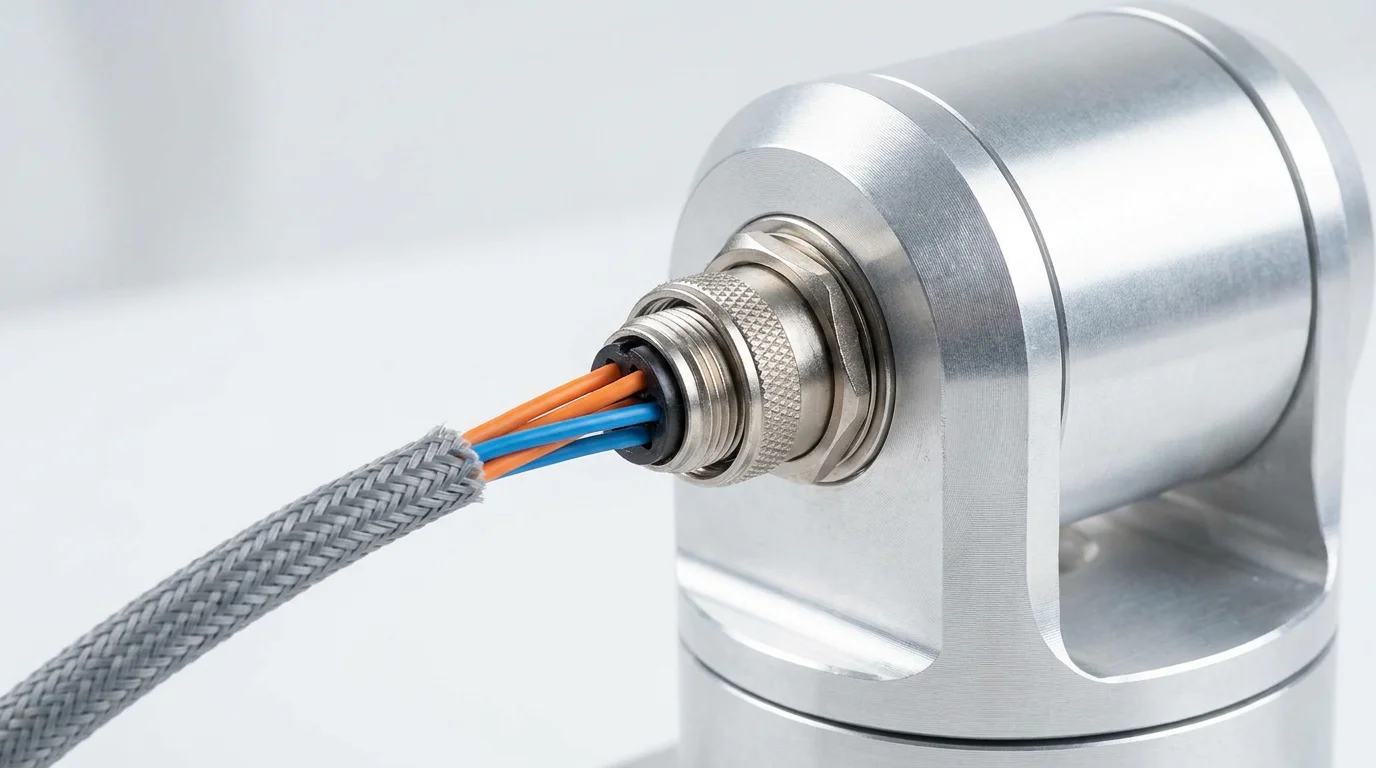
Modules rated IP65 withstand water jets, suitable for washdown and harsh industrial environments.
Step 5: Environmental Considerations
Where will your cobot operate?
- Clean factory floor: Standard
IP54is sufficient. - Food & beverage, wet environments: Minimum
IP65. PlaPivot PP-series meets IP65 with sealed connectors and O-ring flange sealing. - Medical / cleanroom:
IP65orIP67. Check for USP Class VI or ISO 13485 requirements for surgical applications. - Outdoor / harsh environments: Require IP67 + anti-corrosion coatings. Consult your robot joint module manufacturer for custom sealing solutions.
3. Red Flags When Evaluating Suppliers
- No published torque-speed curves: Any serious joint module manufacturer provides dyno-tested curves with every datasheet.
- Vague backlash spec ("low backlash"): Demand a numeric value in arc-minutes or arc-seconds.
- No sample program: Can you buy 1–2 evaluation units before committing to volume? PlaPivot has no MOQ for standard models.
- No CAD models: STEP/SolidWorks files should be available immediately upon request.
- Slow technical response: If engineering queries take more than 48 hours, they won't be faster during integration issues.
4. Summary: The Selection Checklist
- ☐ Calculated peak torque for all joints with 20–30% headroom
- ☐ Chosen harmonic drive reducer for precision applications
- ☐ Confirmed communication protocol (EtherCAT or CANopen)
- ☐ Verified 23-bit dual absolute encoder configuration
- ☐ Matched IP rating to operating environment
- ☐ Requested torque-speed curve datasheet from manufacturer
- ☐ Obtained STEP CAD models for mechanical integration review
- ☐ Ordered evaluation samples for bench testing
5. Next Steps
Choosing the right cobot rotary joint module is a critical decision that impacts your robot's performance, reliability, and BOM cost. The good news: with an integrated harmonic drive actuator, most of the complex electromechanical integration is done for you.
Need help sizing joints for your specific cobot design? Contact our engineering team with your application requirements. We provide tailored torque-speed analysis, CAD models, and recommendations within 24 hours.
Need a Custom Robot Joint Module?
Tell us about your cobot project. We'll recommend the right modules and provide a quotation within 24 hours.
Request Quote & Datasheet